Planetarium visitors always have lots of questions about black holes – what would happen if we fell in? How can we see a black hole if no light can get in or out? What is on the other side of a black hole?
What is a black hole?
Black holes are objects in the Universe which have such strong gravitational force that they can trap light inside them. Once light is pulled in, it can’t get out. The escape velocity required would be faster than even the speed of light. To have so much gravity that even light can’t escape, the object would have to be unbelievable dense. Physicists think that such an object can form when a giant old star burns through all its fuel and so explodes into a supernova. The star then collapses down into a very small and dense object – a neutron star or a black hole.
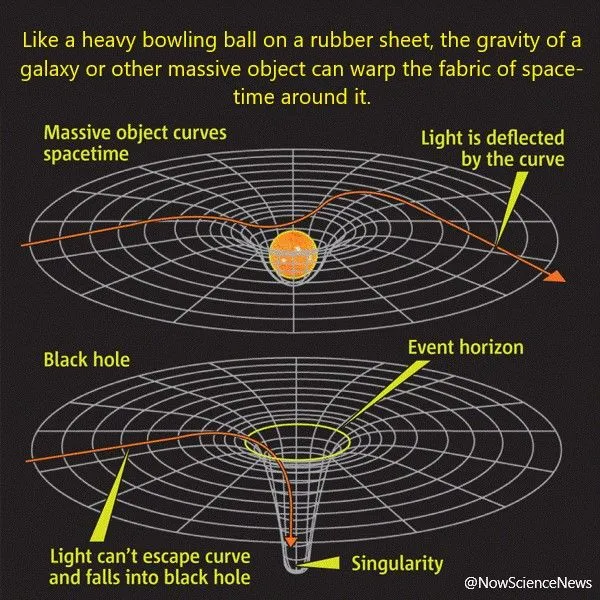
Any object with very strong gravity can bend light. Astronomers figured this out in 1919, using a phenomenon called ‘gravitational lensing’, where light is distorted by a strong gravitational field such as that of our own Sun. Einstein’s work on relativity suggested that very dense objects with super gravitational force also bend space and time – the very fabric of the Universe. This image illustrates how this happens.
https://i.pinimg.com/originals/b9/4b/e2/b94be252efe6d80438cb1a5161261c43.jpg
What would happen if you went near a black hole?
The idea that a black hole can bend space and time is hard to wrap your head around. If you were able to travel faster than light and get close to a black hole, time would seem to slow down so that it might take you years to fall into the hole! Your body would definitely experience the effects of the enormous gravitational forces. You might get flattened like a pancake or get stretched out like spaghetti. But luckily, you probably wouldn’t be awake to feel any of the effects. We don’t really know exactly what would happen, but if we went past the event horizon we would likely never come back.
There are some people who think that a black hole might be an opening to a wormhole where matter might shoot out the other side through a ‘white hole’, but that is just conjecture at this stage!!
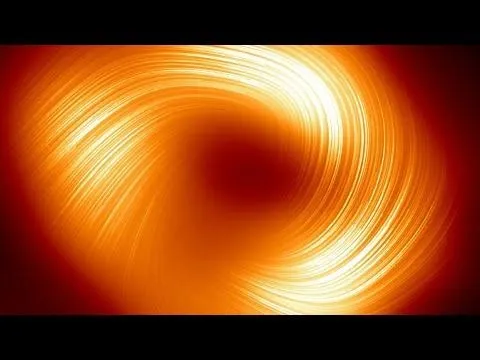
We do know that black holes ‘eat’ anything that comes into their event horizon. They are active, surrounded by super strong magnetic fields. Black holes are definitely a health hazard – to humans and to stars!
Have a look at this video from the EHT to see the magnetic field surrounding the Milky Way’s black hole :
https://www.youtube.com/watch?v=4FYRVbrBP7g&t=82s
So, can we see a black hole through our backyard telescope?
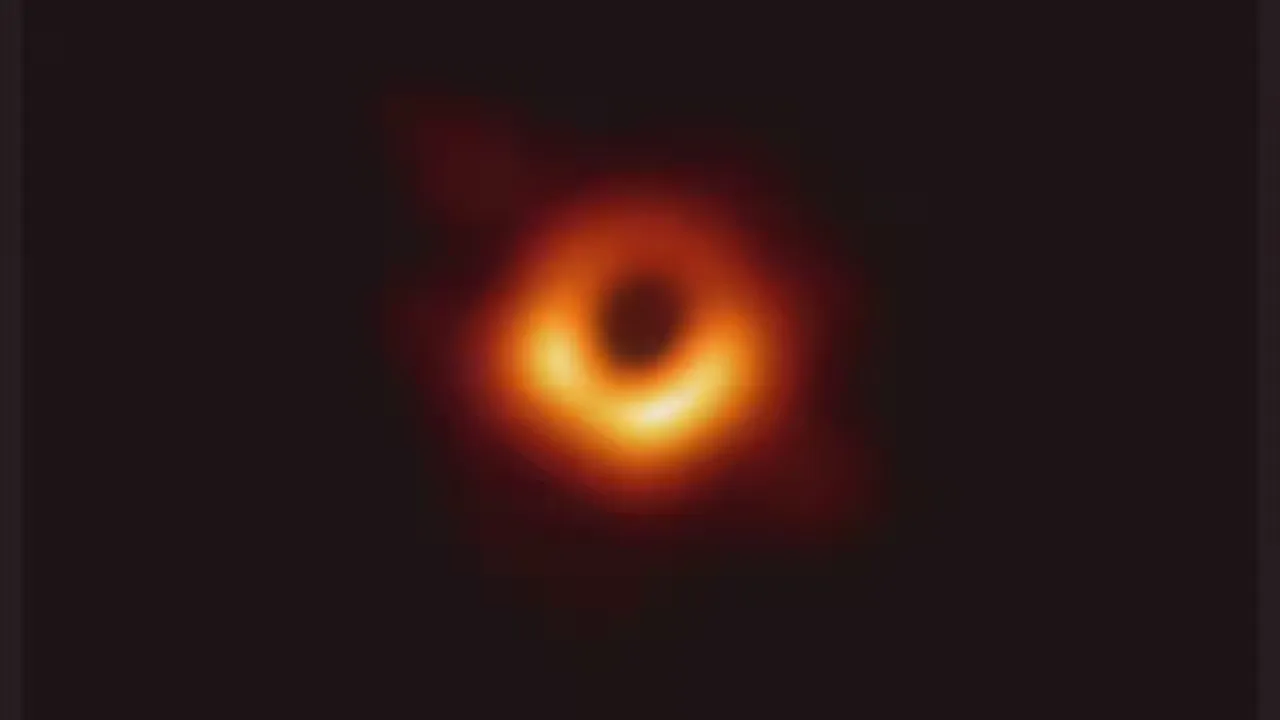
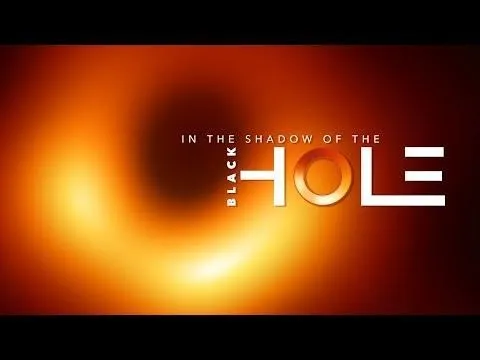
No, we can’t actually see a black hole because it is invisible – no light can escape remember! But in 2019, astronomers at the Event Horizon Telescope (EHT) succeeded in taking the very first image of the spinning plasma, called the accretion disk, surrounding the black hole at the centre of a galaxy known as M87. This image caused a great deal of excitement because it was our very first glimpse of a black hole.
https://images.firstpost.com/wp-content/uploads/2019/04/Black-Hole.jpg
So exciting! Looks like a donut doesn’t it? That bright disk contains gas and plasma which the black hole sucked up from any stars that ventured too close.
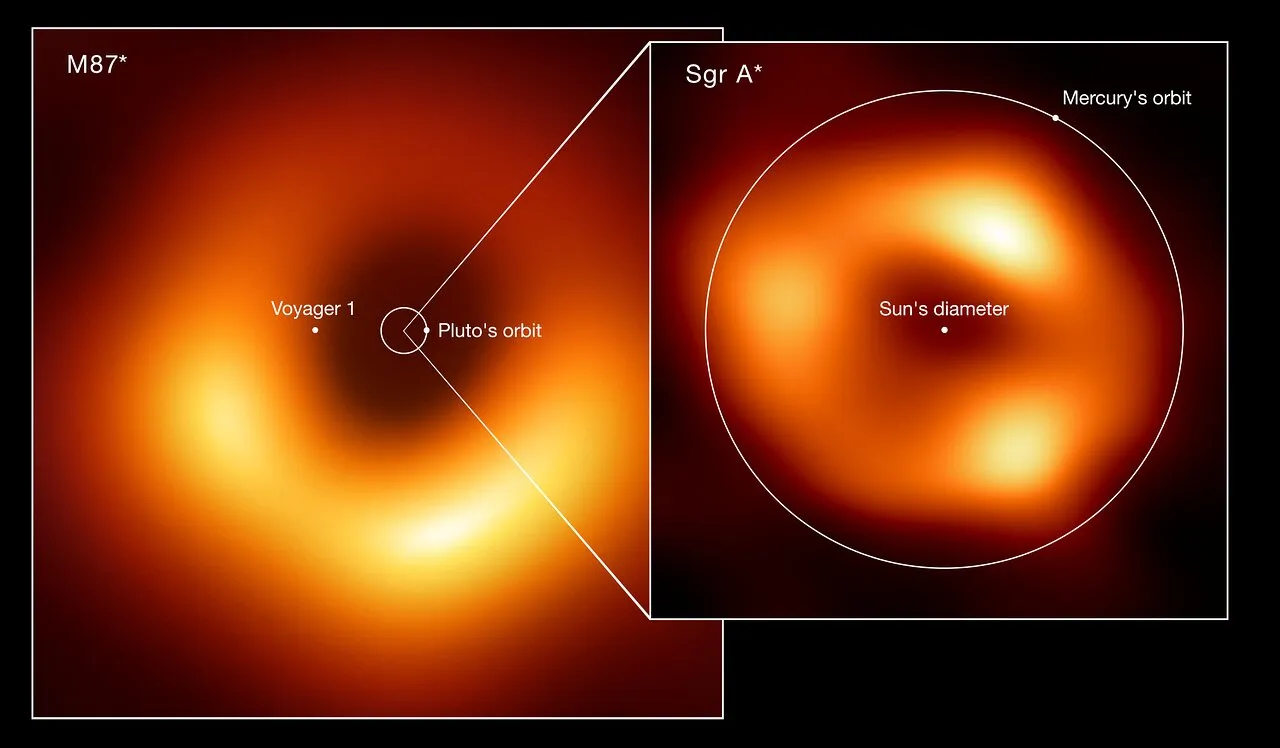
We had to wait a few more years for an image of the black hole in our own galaxy, because we had to peer through a lot of dust. In 2022, the EHT released an image of our own Milky Way’s black hole, called Sagittarius A star (Sgr A*). Ours is a bit smaller than M87’s massive one, as you can see in this side-by-side image of the two black holes. Both images were taken using the EHT. Some comparison distances are included so you get an idea of just how big these gravitational monsters are.
https://assets.iflscience.com/assets/articleNo/63653/iImg/55521/1652362412-eso2208-eht-mwe.jpg
If you would like to learn more about the quest to take an image of a black hole, have a look at this video.
https://www.youtube.com/watch?v=omz77qrDjsU&t=320s
How many black holes are in the Universe?
Astronomers have found evidence that there is likely to be a black hole at the centre of most galaxies. They have even found that there are probably black holes in the centre of many globular star clusters. Given that there are millions of galaxies and star clusters, that makes a lot of black holes.
Recently astronomers have been thinking about whether there might be tiny black holes all over the Universe and if so, would we be able to harness their energy to help us to explore the Universe?
Come look at the centre of the Milky Way with Sidewalk Astronomy
We can’t see Sgr A* though our telescopes, but we can find the galactic centre of the Milky Way!
Join the friendly members of the Astronomical Society as they share their telescopes and knowledge to help you peer into the cosmos.
Where: Just outside the Discovery Centre
When: Friday 6 June at 5.30pm
Weather permitting of course. Let’s hope for a cloud free night!
Sign Up To Our Mailing List