In our next episode, we will explore another question often asked by our curious Planetarium visitors:
‘How was Earth Made?’
Last time, we thought about how the Universe began. We learned about the theories of Inflation and the Hot Big Bang, which we think took place about 13.8 billion years ago. After the Big Bang, things gradually cooled down enough to allow primordial elements to form – mostly hydrogen, helium and some lithium. Eventually, the effects of gravity led to clumps of matter forming which became stars and then galaxies.
Around 4.6 million years ago, our Sun was born as a protostar in a cloud of molecular gas and dust likely caused by another star going supernova. This dust and cloud swirled around the young Sun in a rapidly spinning protosolar disk like the one in this illustration from NASA .
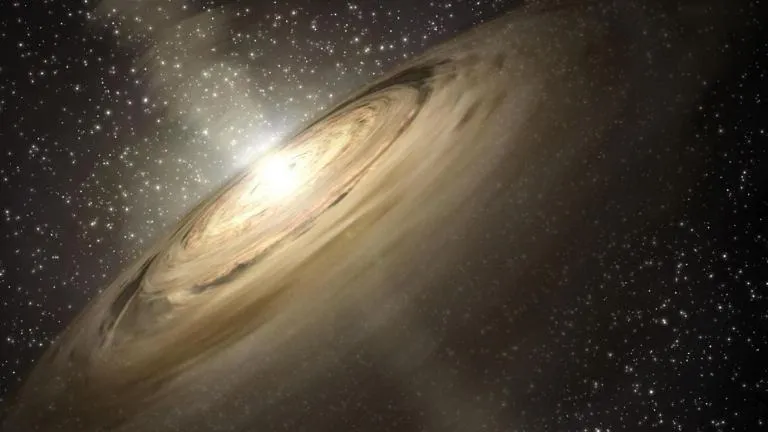
Protoplanetary disk around a young star. Image Credit: NASA/JPL
Over millions of years, tiny particles of ice and dust began to clump together into very small pebbles in the icy outer regions. These pebbles drifted in closer to the Sun and began to build up into larger planetisimals. Astronomers think that the gas giants like Jupiter and Saturn may have formed early in the development of the Solar System but were pushed further out due to solar winds and gravitational disturbances.
The pebbles closer to the Sun accumulated to reach a big enough size to kind of suck up other pebbles of dust around them to form rocky planets like Earth and Mars. Earth is about 4.543 billion years old. Early Earth was a bubbling ball of volcanoes and was hit by asteroids on a regular basis. We call this time Hadean Earth – kind of hell on earth.
Thank goodness things settled down enough to allow life to take hold on our planet. Life finally emerged on Earth about 3.8 billion years ago.
There is still a lot of debate about exactly how the planets formed and how long it took, but researchers agree that the early Solar System was a violent and dynamic place with asteroids and small planetesimals moving around under gravity and crashing into each other. The night sky might look calm and quiet now but the early solar system was very active.
Space exploration missions are now looking for signs of life on other Solar System planets and moons like Mars, Enceladus and Europa. Recently, researchers have proposed that both Uranus and Neptune may have a hot inner core with an ocean beneath the icy surface so these seemingly cold, desert-like planets may also be worth exploring for signs of life.
Here is a little animation from the Space Telescope Science Institute which shows how the Solar System and earth may have formed.
https://www.youtube.com/watch?v=7C-Ze_kRjsM
See it for yourself!
If you would like to see some of the planets in our Solar System and other night sky objects, come visit Sidewalk Astronomy outside the Discovery Centre on Friday 13th December. Members of the Astronomical Society of Victoria will show you around the night sky through their telescopes!
Sign Up To Our Mailing List