Is there a second moon orbiting Earth?
Good heavens – do we have another moon that we didn’t know about? There have been a few ‘news’ items floating about claiming that we have found another moon orbiting Earth.
Last month, we celebrated International Observe the Moon Night. Many of us ventured outside to look more closely at our moon. We could only see one moon though, so what’s going on?
Is there any truth to the story?
What is a moon anyway?
Before astronomers can agree on whether we have found a new moon orbiting Earth, they need to agree on the definition of a moon.
Technically, a moon is an object which is in orbit around a larger non-stellar object. So a moon is really a kind of satellite going around a larger planet, moon or asteroid.
But hang on, does that mean that the thousands of man-made satellites whizzing around Earth can be called moons? Well, no they can’t, because these satellites are not natural and they are short-lived.
So moons also have to be natural objects, orbiting larger objects, over long periods of time.
And size matters. The tiny icy, dusty and rocky fragments which make up the rings of, say, Saturn or Uranus, are too small to be called moons even though they are natural, in orbit and hang around for ages.
Anything smaller than a few hundred feet is called a moonlet – not a moon.
There are all sorts of moons.
The latest count of ‘moons’ around Saturn is up to a whopping 274. With better telescopes, like the James Webb Space Telescope, astronomers are finding more all the time. Just this August 2025, JWST found another moon hiding in the rings around Uranus, bringing the total confirmed number of moons around that planet to 29.
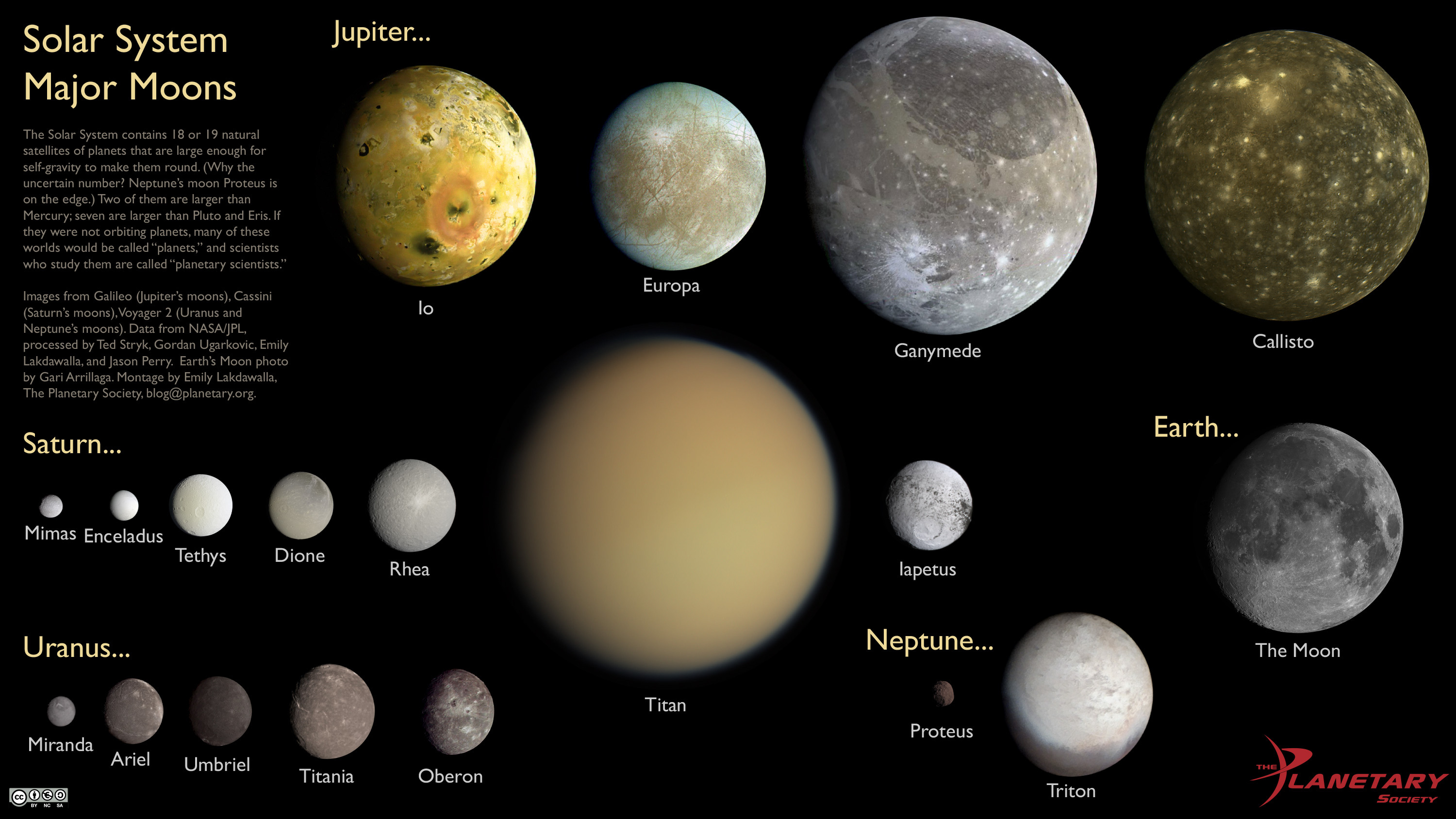
Not all moons are round like a ball. There are about 20 major moons in the Solar System which do have a rounded shape, sculpted by gravity. Smaller, minor moons can look lumpy, like Phobos and Deimos which orbit Mars.
Here are some of the major round shaped moons in our Solar System:

And here are the smaller, odd-shaped moons of Mars:

Image address: https://i.pinimg.com/originals/48/bc/e9/48bce9c541fe04c4e71cd5ab7876abfb.jpg
Source: aasnova.org
So some moons are round while others look like big hunks of rock travelling around their big friend.
How many moons are in the Solar System?
Currently, astronomers have estimated that there are almost 900 moons, that we know of, orbiting planets, minor planets, moons or asteroids in the Solar System. That’s a lot! And if you think that’s a lot, an astronomer working in Taiwan’s Institute of Astronomy, thinks that there could be up to 10,000 moons hanging around the Solar System! The new Vera Rubin Observatory can spot moving objects so we could end up finding many more.
There are no moons orbiting around Mercury or Venus, the two planetsclosest to the Sun. Here on Earth, as far as we know we have one large moon while Mars has two small moons. As we move further out, the giant planets have more, with Jupiter’s moons totalling 95 -- including the largest one in the Solar System (Ganymede). Saturn has a whopping 274 moons, Uranus has 29 and Neptune has 16.
Even smaller dwarf planets have been found to have moons. Pluto has five natural satellites with one of them, Charon, almost as big as Pluto itself. There are eight other dwarf planets living in the Kuiper Belt and they have nine moons between them.
So moons are pretty common, orbiting almost every large object in the Solar System (except for Mercury and Venus). The early Solar System was a pretty wild place with lots of rocky asteroids and planetesimals around. It is not surprising that smaller objects gravitated towards larger ones.
Could Earth have more than one moon?
Astronomers are calling 2025 PN7 a ‘quasi-moon’. It is not round, looking more like a dark, uneven rock.
Unlike our own Moon,it is not gravitationally bound to Earth, instead it is moving along a path which is synchronised with our own orbit around the Sun From here on Earth, it seems like it is going around us, but it is really travelling around the Sun. You can see this more clearly in the illustration below, from Earth Sky Magazine:

With thanks to earthsky.org. ‘Newly discovered quasi-moon 2025 PN7 shares a similar orbit with Earth. But from Earth’s perspective, it appears to orbit us’. Image via NASA.
Belonging to the Arjuna asteroid group, 2025 PN7 is the size of a small office building and will be travelling with us for the next 60 years or so, after which 2025 PN7 will drift off to continue its journey around the Sun. Aren’t we lucky!
Apparently, it has been shadowing us for about 60 years but it is so small it can’t be seen easily. With the new larger telescopes we have developed, we have finally spotted it.
Check the Facts!!
Sometimes it is hard to know what to believe on social media.
Earth does not have a second moon despite all the buzz. We do have a little companion which NASA is calling a quasi-moon. Researchers from the University of Hawaii, have estimated that we have at least 6 quasi-moons in loose orbit around Earth, all of which will gradually drift off into space.
So, no need to worry -- astronomers do not believe that this quasi-moon poses any threat to us here on Earth!
NEWS UPDATE on 3i/ATLAS interstellar comet
You may remember that we talked about our interstellar comet visitor a few episodes ago.
Everything went quiet while the comet moved out of sight as it travelled closer towards the Sun. 3i/ATLAS will make its closest approach to the Sun on October 29, after which it will start heading back towards Jupiter. The closest it will come to Earth will be on December 19th.
So far, 3i/ATLAS has behaved pretty much like other comets we regularly see in the Solar System. Some recent images captured the comet spitting out a giant jet of gas and dust, in the direction of the Sun – just as we expect comets to do as they heat up close to our star. Comets can end up with a sun-facing jet and another tail facing away from the Sun – a tail at either end!
Right now, the comet is behind the Sun, so we can’t see it at all. It will return to our skies around November 11, though you would need a pretty good telescope if you wanted to see it.
As the comet continues away from the Sun, several spacecraft currently on missions in the Solar System are likely to pass close by. The European Space Agency’s Jupiter Icy Moons Explorer (JUICE) will observe the comet with a range of instruments, but we won’t get the data till next year.
In addition, NASA’s Europa Clipper which is travelling to Jupiter’s moon, Europa, may be able to examine the material from the tail of the comet. This is exciting, since it will give us a unique insight into the composition of an ancient interstellar object.
Here is the comet’s path over the next few months:

Source: https://i3atlas.com/trajectory
You can follow the interstellar comet live at https://i3atlas.com/trajectory
Here is a fantastic image of the comet and its tail captured by the Gemini Multi-Object Spectrograph (GMOS) in September 2025, on Gemini South at Cerro Pachón in Chile.,
https://cdn.jwplayer.com/previews/uSMVpmHJ
FACT CHECK ALERT
Again, there have been many theories put out there about the nature of 3i/ATLAS. So far, the object is behaving just like a comet, not an alien spacecraft.
Sidewalk Astronomy on Friday 31 October!
Please join the members of the Astronomical Society of Victoria (ASV) as they set up their telescopes outside the Discovery Centre in Bendigo on Friday. Who knows, we might even see a comet since there are several passing by now including Comet C/2025 A6 (Lemmon); Comet C/2025 R2 (SWAN); and Comet C/2025 K1 (ATLAS).
Where: Marketplace Carpark, Bendigo
When: 8pm –10pm, 31 October 2025
Hope to see you there – and fingers crossed that the skies are free of clouds!
Check the website for weather updates.
Sign Up To Our Mailing List