Do you look forward to the summer holidays and the beach; enjoy autumn colours; love the crunch of frost in winter and get excited by the first growth in spring?
You might also wonder how come it is so hot in the Victorian summer yet so freezing in winter? Some people say that we can have four seasons in just one day around here, so you better wear layers!

Source: www.3aw.com.au
And hang on – how come people who live near the Equator have warm weather just about every day? And why is everything back to front in the northern hemisphere, winter in December and Summer in July! What the!!!!
Slow down!!
Let’s have a think about the seasons -- about what makes them tick.
Why do we have seasons in the first place?
Our beautiful planet, Earth, is on a journey around the Sun – following our gravitationally- driven orbit - which takes about 365 days to complete. This trip is not perfectly round – it follows an elliptical path, kind of like an egg shape. So sometimes we are slightly closer to the Sun, sometimes a little further away. Nothing to worry about though.
At the same time, we spin on our axis, like a spinning top. One full spin takes us 24 hours, or one day.
But Earth’s spinning axis is actually tilted. We are on an angle of about 23.5 degrees away from the orbital plane, the imaginary line that we follow as we circle the Sun.
We are kind of tipped over like this:
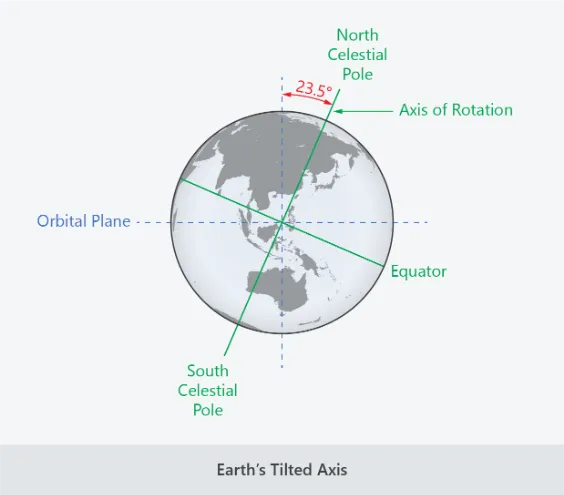
Source: goodscience.com.au
The early days of the Solar System were pretty chaotic, with asteroids and planetisimals flying around and crashing into one another. Astronomers think that one of these major collisions knocked Earth over a bit, leading to a tilt in its axis. Earth does always point in the same direction towards the North celestial pole as we spin so don’t worry, we won’t fall completely over (like Uranus!).
You wouldn’t think that a little tilt would matter in space, where you don’t really know up from down. But this tilt does make a difference to which part of Earth is facing the Sun as we travel around her.
Have a look at this video showing what happens:
https://youtu.be/vDgUmTq4a2Q?si=MWyN9NteuaAEiIOb
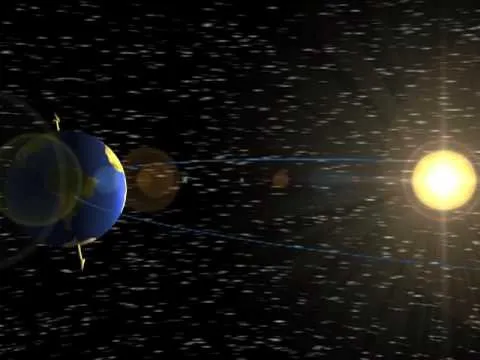
If you live on the Equator, your part of the world is always facing directly towards the Sun. The days near the Equator are long and sunlight hits the ground at almost 90 degrees so it is really concentrated. That means that it is always hot near the equator.
But as you move further South or North, the angle that sunlight hits the Earth changes. This results in different seasons, depending on which hemisphere is tilted towards the Sun. In the summer season, daylight hours are longer and the Sun is higher in the sky, meaning that the weather is warmer. In winter, the days are shorter and the Sun is lower in the sky, resulting in colder temperatures.
You can see this illustrated in this image from NASA:
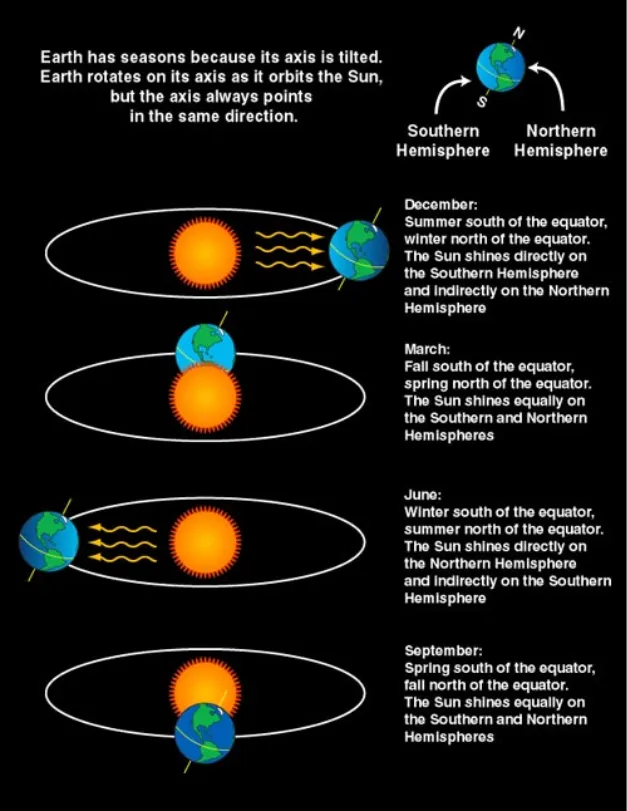
Source: https://spaceplace.nasa.gov/seasons/en/
The idea of the four seasons grew out of the western scientific tradition which evolved in the Northern hemisphere – mostly in Europe. Knowing about seasons helped farmers, fishermen, hunters and horticulturalists to plan and manage their year. In times of war and expansion, an understanding of the seasons would have also played a part in military strategy. For us, knowing about the seasons helps us plan for holidays, think about what to wear, plant out our veges and get ready for rain, heat, wind, snow or just take advantage of a beautiful day.
First Nations people believe we have more than four seasons
Other cultures around the world have different ways of describing and thinking about the seasons.
In Australia, First Nations peoples have a deep understanding of the patterns in nature and are aware of tiny changes in the world around us. First Nations Peoples base their seasonal calendars on local observations of rainfall, wind patterns, animal and plant behaviours, and the position of stars and constellations. Their Seasonal calendars can include many more than four seasons, with some peoples counting up to twelve distinct changes throughout the year.
For those of you who would like to explore how our First Nations peoples have understood the seasons, the CSIRO has worked with Indigenous partners to document a number of local calendars. You can have a look at some here:
https://www.csiro.au/en/research/indigenous-science/Indigenous-knowledge/Calendars
Uncle Rick Nelson and Daikota Nelson, local Dja Dja Wurrung people, have developed a beautiful seasonal calendar which is available through Mt Alexander Shire Website:
Do you agree with our First Nations friends who think there are many more than just four seasons? How many would you count?
Do other planets have seasons?
The short answer is YES! Any planet with a tilt will have seasons – if there is no tilt then there is no change in how sunlight reaches the planet. Have a look at this graphic and see if you can work out which planets are likely to have seasons.
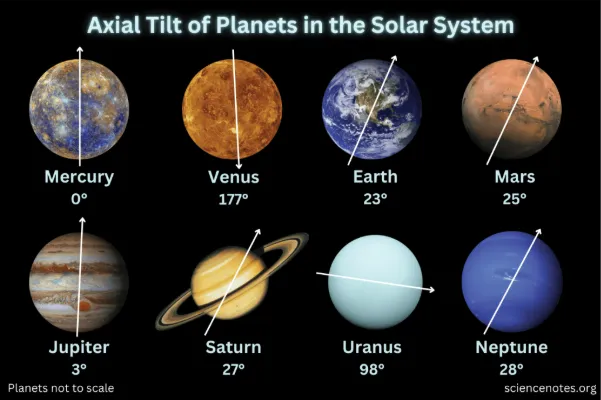
You can see that Mercury and Venus don’t have much of a tilt so they don’t have seasons like us. Mercury has a hot side which faces toward the Sun and a colder side which turns the other way. Venus is always hot, hot, hot.
Mars has a tilt which is very similar to ours – we know that Mars experiences seasons like we do – except a bit colder! Knowing that there are seasons on Mars will help explorers to plan missions.
Saturn, Uranus, Neptune and Pluto all have axial tilts. They do have seasonal variations but they are very different from the ones we experience on Earth. Can you imagine what the seasons might look like on Uranus which is tilted way over on its side?
What can you find out about seasons on other planets or even moons?
Fun Facts about Seasons
Come enjoy the Summer sky with Sidewalk Astronomy
The Bendigo members of the Astronomical Society of Victoria (ASV) will hit the footpath on Friday for the first Sidewalk Astronomy event of the year.
You will be able to look through their telescope at some of the objects in our Summer sky – like the Orion Nebula, Saturn and the Pleiades. It is a great chance to explore the sky and learn from the friendly team.
We will point the scopes at the sky at around 9pm outside Discovery in the Marketplace carpark.
Check for weather updates on the Discovery website.
Sign Up To Our Mailing List