An eclipse that’s what! WOW!
You may have heard that there will be a total eclipse of the moon early in the morning of September 8. You will have to get up around 3.30am if you want to see it IRL!
A total lunar eclipse happens when the Moon, the Earth and the Sun are lined up so that the Moon is covered by the Earth’s shadow (called the umbra). The moon will be ‘standing’ behind Earth’s shadow.
Here is what it will look like over a period of about 5 hours that morning.
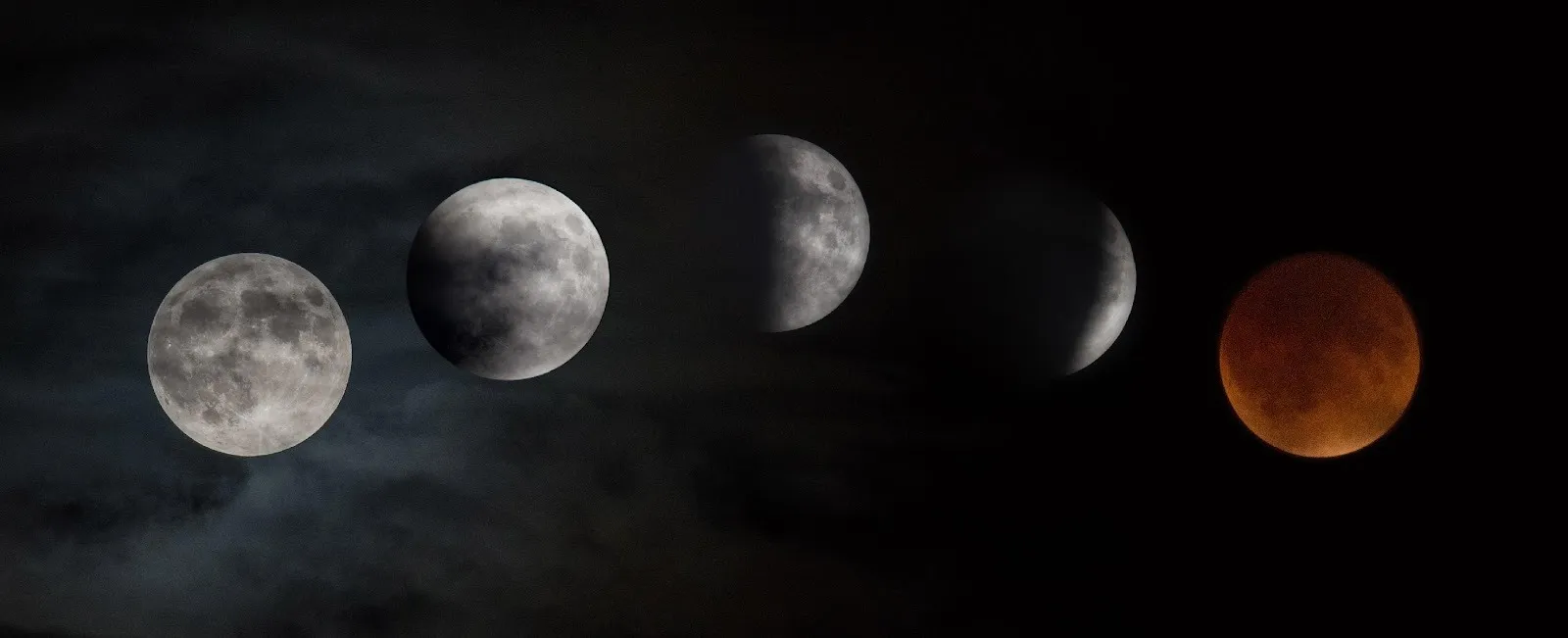
A supermoon lunar eclipse photographed during its progression over NASA's Glenn Research Center Sept. 27, 2015. (Image credit: NASA/Rami Daud)
Image address: https://cdn.mos.cms.futurecdn.net/feqSDkASZiUeiRusEcZeJm.jpg
A lunar eclipse can only happen during a full moon, but it does not happen EVERY full moon – at most about twice per year.
Because the Moon’s orbit is tilted at roughly 5 degrees compared to Earth’s orbit, the two objects do not always line up perfectly.
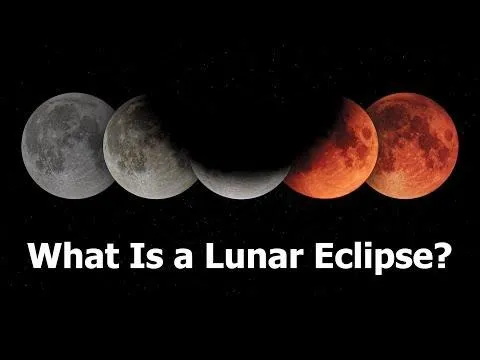
Check out this video to see what this means.
https://www.youtube.com/watch?v=DjcDulGtO0w
What about a solar eclipse?
A Solar eclipse happens when the Moon lines up in between Earth and the Sun and so blocks out the sunlight falling on Earth. The next total Solar eclipse will be visible from parts of Australia in July 2028. During a solar eclipse, daylight gets blocked out on Earth, so everything goes dark and it is all pretty spooky. But also spectacular!
BUT BEWARE: You need special glasses to look at a solar eclipse because looking directly at the Sun will seriously damage your eyes.
What does a total lunar eclipse look like?
During a total lunar eclipse, Earth’s atmosphere scatters the blue light away from the Moon. Light in the red spectrum then falls on the Moon making it appear red. This is known as a Blood Moon.
This diagram shows how this works:
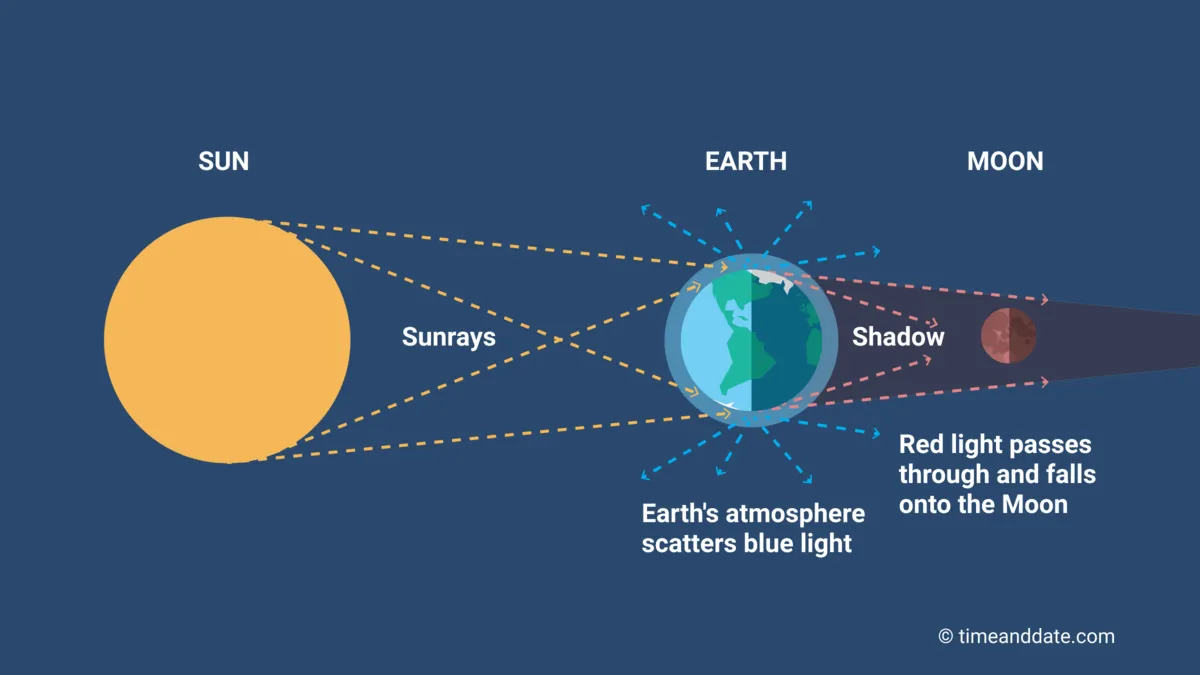
Blood Moon is not a scientific name – people just call it that because of the scary red colour.
Many cultures have stories about the Blood Moon. Often, the blood moon is regarded as an omen or a warning – sometimes bad, other times good.
Dr Kirsten Banks, a proud Wiradjuri woman astrophysicist, tells us:
"For the Lardil of Mornington Island, the moon is a greedy and selfish man who steals food, and as he steals food, he gets fatter and fatter. And that's showing the moon getting bigger and bigger, going through the phases and turning into a full moon.
"But when the moon turns red during this lunar eclipse, they see that as the sudden death of the moon, and that acts as a warning to younger people to not steal food ... reinforcing the taboo of selfishness."
So an eclipse can be both a warning and a wise teacher of life lessons!
When can you see the eclipse?
On 7 September, the moon will rise in the East at 5.30pm. It will be a full moon (hopefully no clouds!!). A full moon always looks spectacular as it rises, so make sure you go outside to have a look.
The eclipse will begin at 1.28am when the Earth’s shadow will start to block light from the Moon. At first it will look a bit like something is taking a bite out of the Moon.
If you can, set the alarm for around 3am so that you will get to see the most exciting part of the event when the Moon is completely in Earth’s shadow. You will need to put on sturdy shoes and warm clothes before you head outside. You will need parents or older siblings to come with you, so you better be nice to them that day!
You will be able to see the Earth’s shadow pass slowly across the Moon. The Moon will be totally in shadow at 4.11am.
The moon will then take on a reddish colour – it won’t be blacked out like during a solar eclipse.
Earth’s shadow will slowly move across the moon – everything will be done and dusted by about 6.40am.
The whole eclipse will take more than 5 hours.
Here is a photo, taken by astrophotographer Rami Ammoun, of the last Blood moon which was visible in America in March this year. How beautiful is that! Remember it was probably taken under very dark skies with a special astronomy camera.
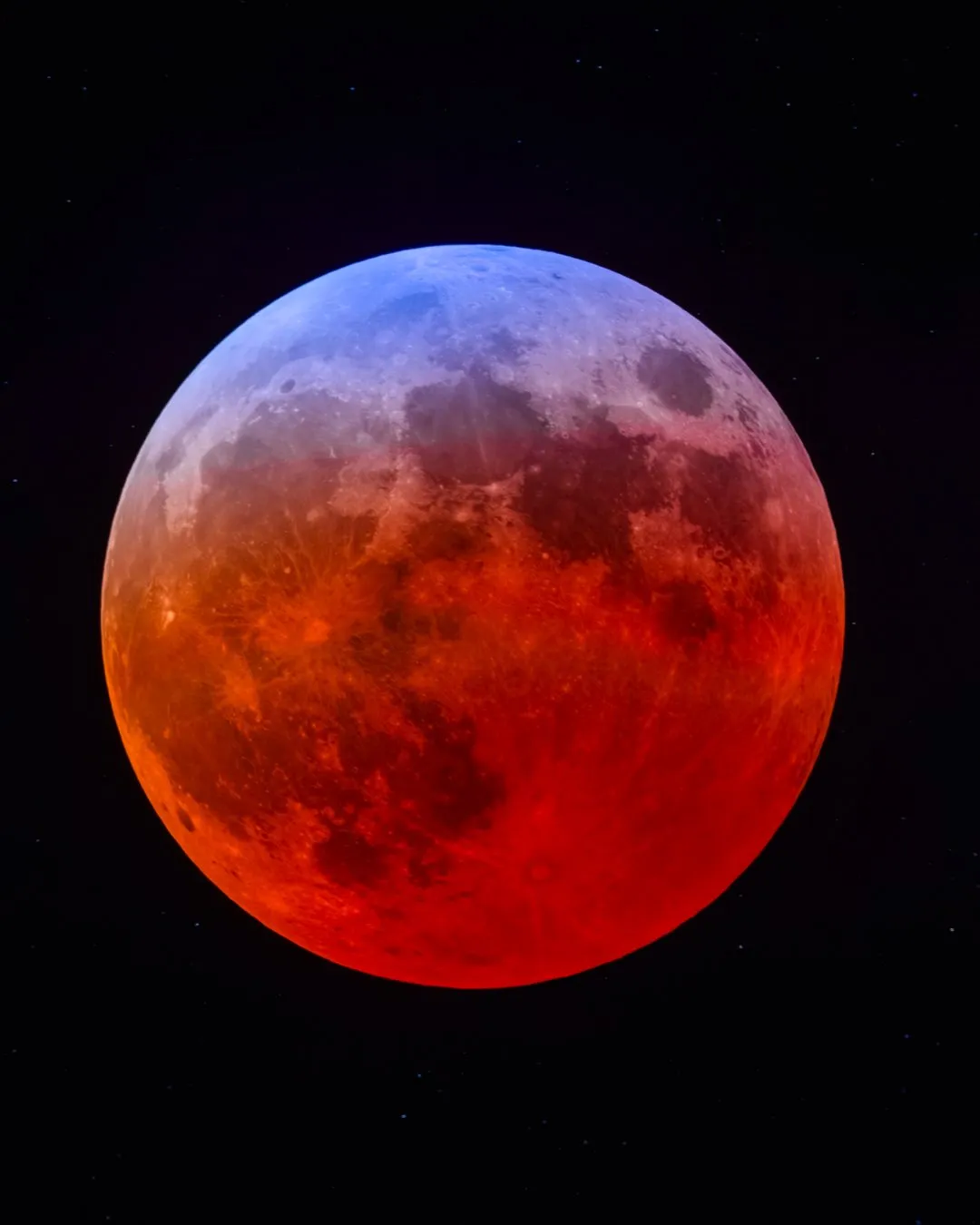
Total lunar eclipse observed on March 13 – 14, 2025. Source: Rami Ammoun in Universe Today
Image address: https://universemagazine.com/wp-content/uploads/2025/03/6.jpg
You might be able to take a video or photo if you have a phone with nighttime capability.
Send your images in to Discovery! We’d love to share them!
Best place to view the eclipse
The eclipse will be visible all over Australia (though at different times depending on your time zone)
Ideally, the best views are under clear dark skies – like in the country. But if you live in a town or city, you might be able to find a spot somewhere that is not surrounded by trees or buildings.
Even if you have a lot of light pollution from street and building lights, you can still see the Moon in the sky and so will be able to watch the shadow move across it.
If there are too many clouds blocking the sky when you get up, maybe go back to bed.😢
But if you are really keen and want to find out if the clouds will clear up, perhaps check on a weather site like Meteoblue ( Astronomy Seeing Bendigo - meteoblue )
Maybe you will become an Eclipse Chaser!!
October International Observe the Moon Night – October 3 & 4
International Observe the Moon Night takes place on October 3rd in Australia. The Astronomical Society will be holding their usual Sidewalk Astronomy session outside Discovery with a special focus on the Moon.
Check out the info on NASA here: https://moon.nasa.gov/observe-the-moon-night/
Our next blog will zoom in on the moon and discuss what we have learned about our nearest celestial neighbour.
Sidewalk Astronomy: Gazing together at the heavens
The next Sidewalk Astronomy is on this Friday 29 August in the car park near Discovery.
The friendly members of the Astronomical Society of Victoria set up their telescopes for you to look at the sky in more detail.
This month, some of the objects we will look at include the Moon, the Southern Cross stars, the Jewel Box star cluster, and Alpha Centauri – the nearest star system to us at about 4.3 light years away.
Hope to see you there – weather permitting of course.
Sign Up To Our Mailing List