Why does Saturn have lots of moons?
Saturn is the sixth planet from the Sun, just past Jupiter, and is surrounded by the stunning icy rings which we can see when we look through even a small telescope. Like Jupiter, Saturn is a gas giant, made of mostly hydrogen and helium. It has a diameter about 9 times larger than that of Earth – yes, it is huge but because it is made of gas, it would float in a bath if you could find one big enough to hold it! Isn’t it beautiful?
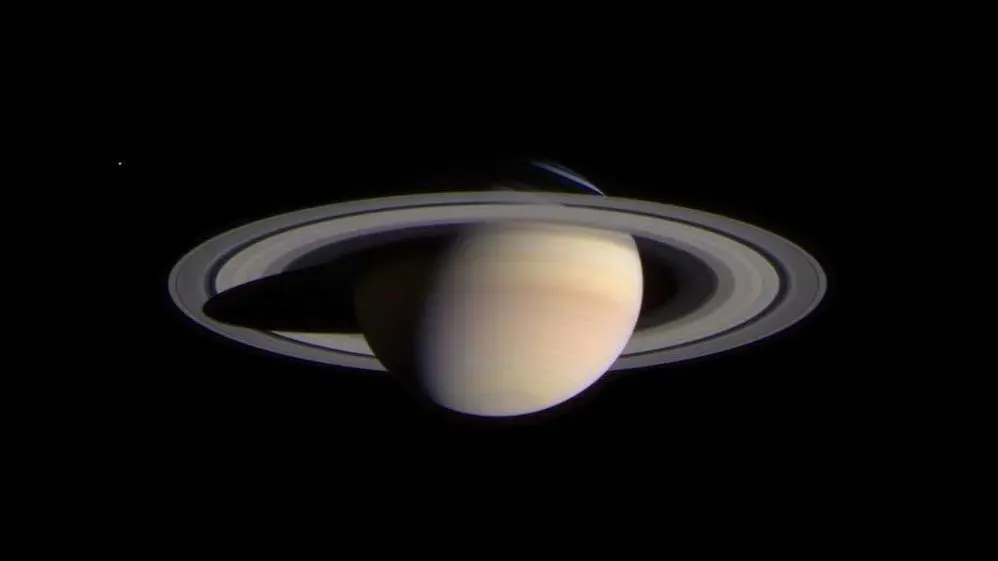
NASA's Cassini spacecraft took this image of Saturn on Feb. 9, 2004, when the spacecraft was about 43 million miles (69 million kilometers) from the ringed planet. The image contrast and colors have been slightly enhanced to aid visibility.
NASA/JPL/Space Science Institute
Many planets in the Solar System have moons or satellites in orbit around them – we have one, Mars has two, but the gas giants have LOTS. At last count (2023), Saturn has a staggering 146 known satellites.
You can find out more about the moons from NASA here:
We can’t see all of the moons very easily but here is an image taken by the NASA spacecraft, Cassini, of the larger moons of Saturn – remember, plenty more are hiding!!
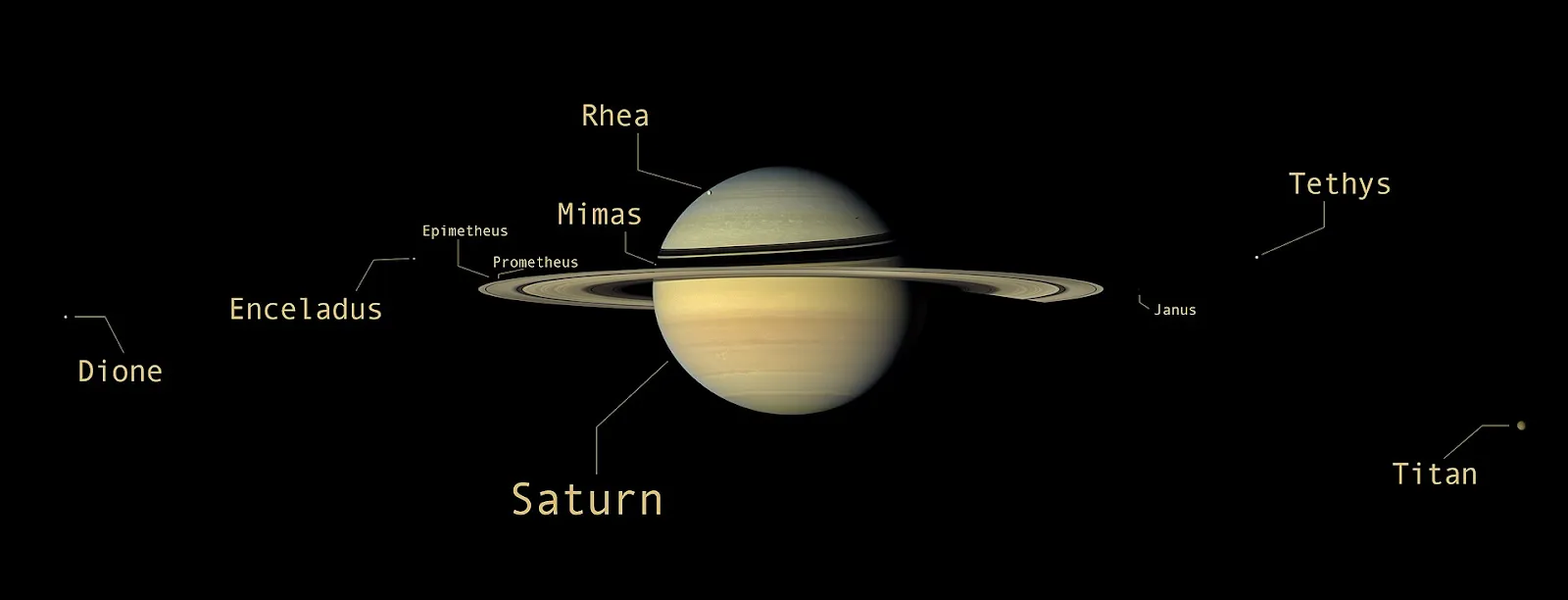
Processed using calibrated red, green, and blue filtered images of Saturn taken by Cassini on September 9 2007. NASA/JPL-Caltech/SSI/CICLOPS/Kevin M. Gill
So why have the gas giants got so many moons?
To understand this, think back to an earlier post (Blog 4) where we considered how Earth was made. The early Solar System was a wild place – starting off as a swirling cloud of gas and dust around the baby Sun. Gradually particles gathered together to form pebbles, then asteroids, then planetesimals, then planets.
Planetary disk winds and gravity meant that these bodies were flying around, crashing in to each other or clumping together to become larger. The huge gas giants attracted lots of smaller bodies around them – and they pushed plenty out of their way as well. Their strong gravity captured some of these rocky, icy objects so that they ended up orbiting the planets to become moons.
Around Saturn, it is thought that the Sun’s gravity may have danced with Saturn’s gravity to destabilise the orbits of some of these objects, causing what is known as resonance (like a vibration in gravity). This resonance created a kind of snowball effect resulting in many high impact collisions. It is believed that a high speed collision of several large icy bodies may have caused icy mantles to break off and spread out to create the beautiful ice rings around Saturn. The rocky cores didn’t disperse so widely, so they became smaller objects or moons. Some of these little moons veered off course and collided with each other. Others moved away from the effects of the resonance and ended up outside the rings. A number of moons stayed inside the rings -- you can see their influence in the noticeable gaps in the ring system itself (see the top picture from NASA).
While things seem pretty calm now, the early Solar System was hectic, with small objects flying around, colliding, forming larger objects and sometimes ending up in orbit around other larger objects. Our own moon is covered in craters from collisions for example.
Saturn and Jupiter have many moons because their gravitational pull is so powerful that many objects were ‘captured’ and held in orbit around them.
Saturn’s moons are of particular interest, along with some of Jupiter’s moons, because of the possibility of life in the oceans beneath their icy surfaces. Enceladus is currently of particular interest to astrobiologists. NASA’s spacecraft, Cassini, spotted plumes of water erupting from the surface of Enceladus in 2010. Water is, as we know, a key ingredient essential to life on Earth. There are plans to investigate further to see if there are the necessary elements for life on Enceladus – is there something living under the ice? Wouldn’t that be amazing!
Here is the image, taken by Cassini, that got everyone so excited! You can see the plumes of water shooting out into space.
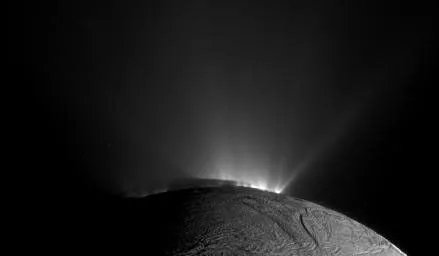
NASA’s Cassini spacecraft captured this image of Enceladus on Nov. 30, 2010. The shadow of the body of Enceladus on the lower portions of the jets is clearly visible.
NASA/JPL-Caltech/Space Science Institute
Sidewalk Astronomy in Friday March 7
If you would like to see a gas giant for yourself, come join the ASV Bendigo Section as we look at the night sky through our telescopes. Currently Jupiter is visible and you might even be able to see some of its moons. Saturn is not visible right now so we will have to wait until later in the year for that.
Telescopes will be setting up after 7.30pm near Discovery in the Marketplace carpark.
Love to see you there!!
Sign Up To Our Mailing List