Will the universe keep expanding?
This is a scary question. Think about it – if the Universe keeps expanding and spreading out further and further then we could end up a very long way from everything else. There would be fewer stars in the sky, it would take even longer to travel to another solar system, the Universe would get darker and darker.
In Blog #3, we thought about how the Universe began. The favoured theory is that the Universe was born with, we think, a Big Bang. It is believed that a period of inflation (or expansion) took place over a very short time span, leading to the gradual development of the stars, planets and galaxies, all connected by the cosmic web of our Universe. This is mind blowing enough, so imagine how astronomers felt when they worked out that the Universe was STILL expanding!
Expansion of the Universe discovered
We first realised that the Universe was expanding around 95 years ago. Edwin Hubble was one of the first to find that there were other galaxies out there, besides the Milky Way – and lots of them. Hubble started trying to work out just how far away from us these far flung galaxies might be. At first this work involved calculating distances by comparing how bright stars appeared from Earth with their actual brightness. This led him to consider how fast any given galaxy was travelling away from us or towards us. We worked this out by measuring the wavelength of light coming from a galaxy. Astronomers found that galaxies which were moving towards us emitted wavelengths that looked blue, while those that were moving away from us looked red. This is called the Doppler shift and we can hear it in real life when we hear the change in wavelength of a siren as it comes close (louder) and then away from us (fades away). This helped us to calculate how fast the galaxies were moving as well.
If you think of the Universe as like a balloon that is inflating, you can get a sense of how the Universe is expanding over time.
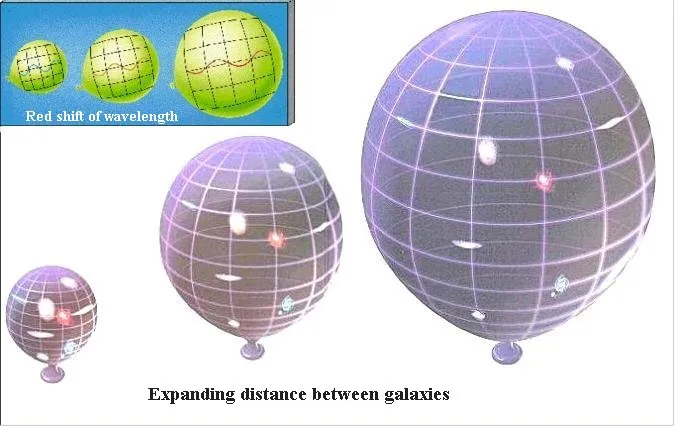
From https://universe-review.ca/F02-cosmicbg01.htm
Once Hubble was able to work out the speed the galaxies were travelling, he looked at the math and realised that the galaxies were actually moving away from us. The only explanation was that the universe must be expanding! Think about it -- inflation was still happening 13.8 billion years after the Big Bang!
The expansion rate was measured and given a number. It was called the Hubble Constant. The Hubble Constant has been important to cosmologists as they try to develop an understanding of how the Universe works.
OMG -- it is accelerating!
But guess what! It turns out that the expansion rate is NOT constant. In 1998, Australian Brian Schmidt’s research team at the ANU, as well as an American team headed up by Saul Perlmutter, independently found that not only is the Universe expanding but it seems to be speeding up, accelerating rather than slowing down over time! Both Schmidt and Perlmutter got the Nobel prize for their discovery.
Dark Energy
OK, so now we have a Universe that is still expanding and it is expanding faster than we first thought.
What could be causing the Universe to speed up?
Cosmologists now think that there could be a mysterious force at play which they have called Dark Energy. We can’t see it, but we think that something is pushing cosmic expansion to go faster. Until recently, cosmologists believed that Dark Energy always behaves the same – in the past, now and in the future.
The challenge is to find out more about this mysterious Dark Energy – what is it, is it real, what does it do?
DESI is on the job
The teams at the Dark Energy Spectroscopic Instrument (DESI) based in Arizona, and their many partners at the Dark Energy Survey (DES), are looking at evidence from a special type of exploding star, called a Type 1a supernova. They are also tracking the way that light warps as it travels through the Universe (weak gravitational lensing). We have some of our own Aussie astronomers, based in Queensland working with the international team on the project.
Here is what DESI looks like:
.
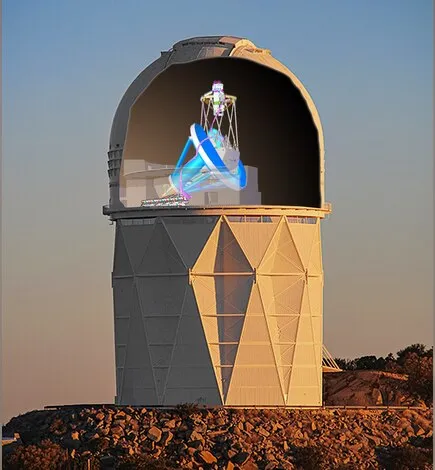
DESI installed on the Nicholas U. Mayall 4-meter Telescope at Kitt Peak National Observatory in Arizona (Source : US Dept of Energy Office of Science. http://desi.lbl.gov)
DESI ‘s goal is basically to make a 3D map of the entire Universe. Wow! Using this map, astronomers are able to pinpoint tiny variations in cosmic movement, called baryon acoustic oscillations. These minute patterns can be used to illustrate the history of the Universe – like how long it has been expanding and whether it has sped up, slowed down or stayed the same.
Here is a glimpse of DESI’s map so far – you can see the cosmic web and millions of galaxies:
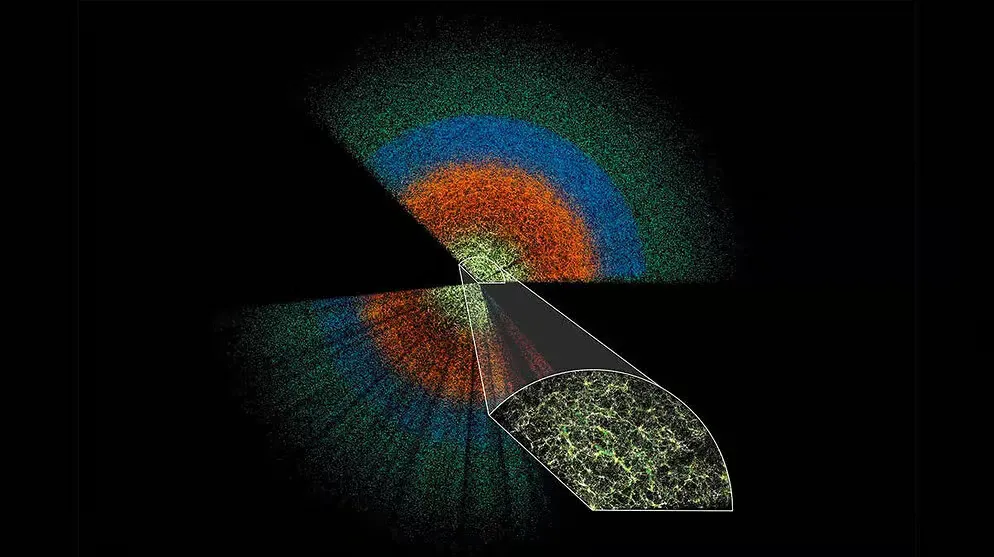
This slice of the DESI data maps celestial objects from Earth (center) to billions of light years away. Among the objects are nearby bright galaxies (yellow), luminous red galaxies (orange), emission-line galaxies (blue), and quasars (green). The large-scale structure of the universe is visible in the inset image, which shows the densest survey region and represents less than 0.1% of the DESI survey’s total volume. Credit: Claire Lamman/DESI collaboration.
Dark Energy might be evolving
The first results released last year suggested that dark energy might not behave as a constant force but that it might be changing over time. When the second batch of data was released in March 2025, the evidence suddenly got a lot more persuasive. It is certainly looking a lot like Dark Energy might be ‘evolving’.
We still need more data, but if the early findings are right, then astronomers will need new physics to explain the Universe.
What it also means is that the fate of the Universe would not just be a kind of fade-out. It could either face a ‘Big Rip’ where an increasing expansion rate tears everything apart OR a ‘Big Crunch’ where everything kind of shrinks down as the expansion rate slows. We need more data before we can answer these questions.
Luckily, we don’t have to worry about it in our lifetime – the end of the Universe is a VERY long time in the future. But it is fascinating to think about.
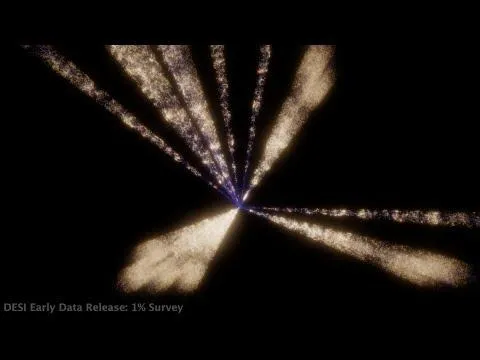
Want to fly through the expanding Universe with DESI? Have a look at this video released last year:
https://www.youtube.com/watch?v=xdJWHXJCxpE&t=30s
Sidewalk Astronomy Friday April 4 @ 6pm
You too can peer up at the expanding Universe with the friendly and knowledgeable members of the Astronomical Society of Victoria (ASV) on Friday April 4th starting at 6pm.
Telescopes will be set up in the car park next to the Discovery Centre. Join us as we gaze in wonder at the skies overhead.
Sign Up To Our Mailing List