Do you think they could have visited Earth?
Could they have come to our skies in flying saucers (UFOs?)
This year, the US Military released classified documents containing reports and photos from people who believed that they had witnessed UFOs (or Unidentified Aerial Phenomena, UAPs). These Top-Secret documents have been kept under wraps for over 80 years, leading to many conspiracy theories popping up, accusing the US Government of hiding the truth about alien visitors.
BUT so far, investigations of the files have yet to reveal any proof that we have been visited by aliens.
The reality is that people are definitely curious about UFO’s or flying saucers. People want to know once and for all whether aliens are real.
Ancient beings coming down from the sky?
Humans have thought about the possibility of extraterrestrial beings for a long time – are we alone in the Universe or could there be lots of other alien civilisations out there?
Many indigenous cultures told stories and drew pictures of powerful beings coming down from the sky.
In Australia, cave paintings, found in the Kimberley region of the Northern Territory, depict strange humanoid creatures known as Wandjina. These beings had huge eyes, no mouths and white faces, surrounded by something that looks a bit like a helmet. Wandjina were said to have come from the sky, bringing civilisation and prosperity to the people. These pictures are over 4000 years old. Could they perhaps represent ancient visiting astronauts?

What do you think? They do look other-worldly, don’t they??
Our First Nations people aren’t the only ones with stories about sky people. Other strange cave paintings have been found which seem to show mysterious creatures wearing what look like spacesuits, helmets, antennas and carrying weapons. Some of these cave paintings have been found in India; in the Sahara Desert; in Peru and in Armenia.
Of course, we don’t really know what these ancient paintings are meant to represent because we weren’t there and can’t ask the painters, but many of the old stories mention beings coming down from the sky.
Ancient Greek Philosophers and Scientists
Anaximander lived in modern-day Türkiye about 2,800 years ago. He thought that Earth is a body floating in an infinite void (in space?) and that there could be many other worlds. Pretty outrageous thinking for so long ago!
One hundred years later, another philosopher called Democritus, also thought that there could be an infinite number of worlds.
He said: ‘It seems absurd, that in a large field only one stalk should grow, and that in infinite space, only one world exist.’
So ---- if there could possibly be an infinite number of worlds, why not an infinite number of beings?
No aliens so far
We are still wondering.
So far, we haven’t managed to find any traces of other civilisations in our own Milky Way – no radio signals, no evidence of technology, no chemical evidence, no nothing.
And we have been looking.
SETI
SETI (or the Search for Extraterrestrial Intelligence) was established by Dr Jill Tarter and Tom Pierson in 1984, after NASA decided to stop funding research on extraterrestrial life. Most of SETI’s early work used radio telescopes to look for radio signals coming from space – like the Dish in Parkes, NSW.
40 years later, SETI has not yet found any evidence of life elsewhere – so far anyway.
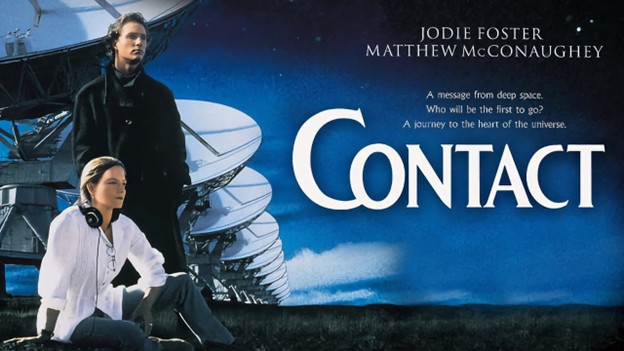
One of my favourite movies, called ‘Contact’, tells the story of a radio astronomer who hears a mysterious signal from space on a radio telescope in New Mexico (the Very Large Array). It is a fictional story but is based on the founder of SETI, Jill Tarter. In Real Life, she did not actually make contact with aliens though. I wish.
Here is a poster for the film. Worth a look.
What about Exoplanets – could aliens live on them?
The first exoplanet was discovered in 1995. Since then, we have discovered over 6000 planets orbiting stars in the Milky Way. We are beginning to find the many worlds that the ancient Greeks predicted.
To date, we have not been able to find out whether any of these planets can support life as we know it. However, our technology is getting better and better every day, so who knows what we might find?
The James Webb Telescope, for example, is helping us to find out which exoplanets have an atmosphere and which have the right sort of chemical composition to support the evolution of life. At the moment, about 45 exoplanets have been listed as potentially habitable and worth further investigation.
Have a look at this video from NASA about the Webb telescope’s role in our search for life elsewhere.
https://science.nasa.gov/asset/webb/2023-webb-science-snippets-exoplanets/
What’s the likelihood of alien life? Try the Drake Equation!
The early Greeks believed that there could be an infinite number of world and so an infinite number of lifeforms.
An American astronomer, called Frank Drake, decided to use maths to see if he could work out just how many advanced alien civilisations might have evolved in the Milky Way. Remember, there are 100-400 billion stars in our galaxy so the chances ought to be pretty good, don’t you think?
In 1961, he developed a mathematical formula called The Drake Equation.
The Drake Equation multiplies seven factors to estimate the number of advanced civilisations which might be capable of sending out electromagnetic signals (like TV or radio).
The equation looks like this:
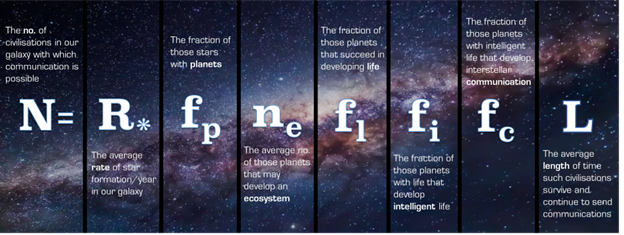
Of course, many variables remain unknown, but we are definitely getting a better idea about some. There is an online calculator you can play around with at
https://www.spacecentre.nz/resources/tools/drake-equation-calculator.html
There is a bit of debate about how many civilistations we might expect to be out there – some astronomers think that there could be very few. Some even wonder if Earth may be the only place where intelligent life has evolved. Others think that we are more likely to find microbial life – perhaps even in our Solar System – rather than intelligent life who could communicate with us.
However, in a recent study conducted by the University of Amsterdam (2026), the authors gave a 42% probability for the existence of advanced civilisations in the observable Universe. That’s not bad odds I reckon. And they reached that estimate despite using very pessimistic scenarios.
So, fingers crossed, we can still hope that aliens DO exist! I reckon we ought to keep on hunting for them – what about you?
The Fermi Paradox
We have been actively looking for alien civilisations for over 40 years now and we have found absolutely nothing.
Enrico Fermi asked this question in 1950 – ‘where is everybody?’
There is a paradox – a contradiction if you like. We know that the necessary elements for life are sprinkled around the whole Universe – water, organic compounds, energy. So why aren’t there aliens all around us?
You would think that there must be other civilisations who have been able to develop the technology to communicate with us and to send ships to other planets in other solar systems. After all, the Universe is around 13.8 billion years old. Plenty of time for clever civilisations to evolve.
But so far – NADA!
Brian Cox explains the Fermi Paradox very well in this video.
So why haven’t we heard from any aliens?
Well.......
What do you think?
Would you like to meet an alien?
Would you get excited if we found evidence of ancient life on, say, Mars?
Do you think humans would be kind to aliens?
Would humans be so frightened of them that they would just decide to destroy them?
As for me – well I’d love to meet an alien, but I guess I would be a bit shy and nervous if I came face-to-face with one.
Time for Sidewalk Astronomy again
When: 5.30pm
Friday 19th June
Where: Marketplace Carpark
Near the Discovery Centre
Come join the friendly ASV members and have a look through their telescopes. They can also help you with your space questions!
If the weather is clear, you might be able to see some planets (like Venus and Jupiter) and some starry constellations. If the sky is cloudy, we won’t see much at all.
I don’t think we will be lucky enough to see any aliens or UFOs though – do you?
Sign Up To Our Mailing List