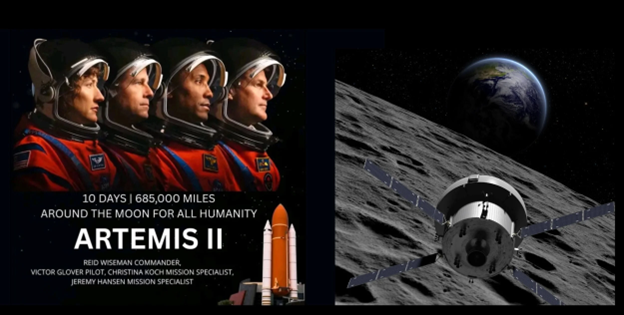
Don’t know about you but I was glued to the screen earlier this month – anxiously holding my breath as the world watchedOrion and her four astronauts head away from Earth on the first day of April(US time), do a lap around the Moon and then splash down safely near San Diego on 10 April. It took 10 days for Orion and her crew to go to the moon, have a look at the dark side, then return toEarth safely.
It was so exciting to watch her lift off!
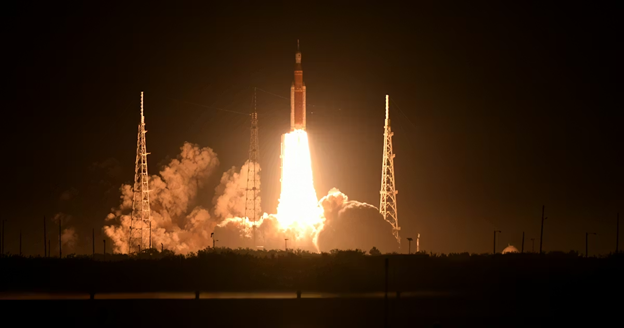
If you missed it, you can watch the launch here on YouTube: And the splash down here:
The Artemis Program
The Orion spacecraft is the second of five missions under NASA’s Artemis program. The program is named after Artemis, the Greek goddess of hunting and the wilderness. She was the twin sister of Apollo. NASA’s first Moon program was named after Apollo.
NASA’s Apollo program was sparked by the challenge posed by President Kennedy in the 1960s, daring the US to reach the Moon by 1970. At that time, the race was on between Russia and America to see who could make it to the Moon first!
The program led to the first humans putting their feet onto the surface of the Moon in July 1969. The final Apollo mission was in 1972 with a total of 12 astronauts having walked on the Moon’s surface.
No human has touched down on the moon since then.
Sometimes I think about those brave astronauts who went to the moon in the 60s and 70s using technology that was barely as powerful as your mobile phone.
Why go to space?
It costs a lot of money to explore space. The technology, the training, the back up services.
You have to be really motivated to launch a spaceship and willing to put in the big bucks, the big ideas, the innovation and the hard work – or you just won’t get there. And don’t forget that it is risky to send people into space. People have died trying to get up there.
And what is the reward?
Well, space exploration has helped us develop things like GPS, medical research, robotics, computer technologies and satellite systems. We have learned more about our own planet, the Solar System, the behaviour of the Sun, the physics of stars and how the Universe works. One day, we may even find extraterrestrial life!
The goals of the Artemis Mission
The Artemis program was set up to return humans to the Moon for the first time since the Apollo Program over 50 years ago. It is a joint mission where NASA works together with space agencies from Europe, Canada, Asia and Australia
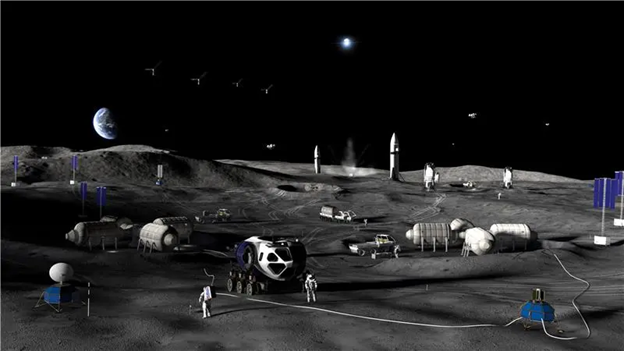
The plan is to launch a series of missions leading up to a crewed lunar landing about two years from now. From there, the goal is to begin building a permanent base on the Moon.
Maybe in the next 10 years, we will be able to look at the moon through our telescopes and see evidence of human activity up there!
I wonder if it will look anything like this!
Artemis II -- A historic mission
This mission has already made history in a few ways:
- First crewed mission to the moon in 54 years
- First time humans looked at the far side of the moon with their own eyes
- Furthest distance travelled by humans from Earth into outer space –406,771km away.
- First crewed mission to the moon since the Apollo program
- First African American astronaut
Maybe you can think of other ways this mission has made history?
Have a look here for all the details of the mission:
https://artemistracker.com/tracker-replay/?archive_tracker=1
What About The Crew?
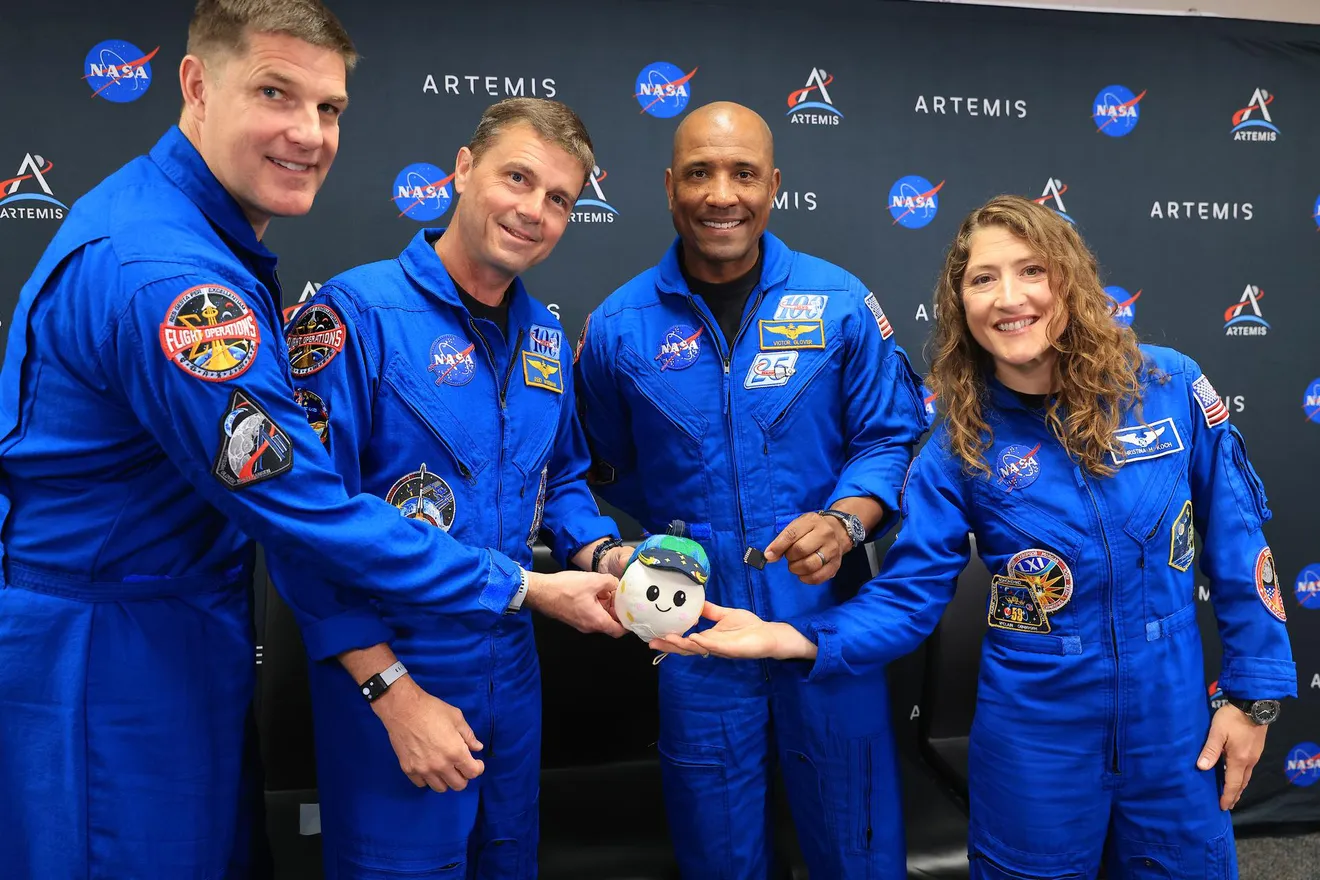
Four super fit, highly trained and amazing people took off to the Moon in the Orion spacecraft:
Their names are:
Commander Reid Wiseman, naval aviator and former head of NASA’s astronaut office.
Pilot Victor Glover, Navy test pilot and first black astronaut assigned to a lunar mission.
Mission specialist Christina Kock, record for longest spaceflight by a woman and part of the first all-female spacewalk.
Mission specialist Jeremy Hansen, Royal Canadian Air ForceF-18 pilot and first non-American sent beyond low Earth orbit.
Imagine being stuck in a tin can, not much bigger than a campervan, for 10 days – with nowhere to hide. I reckon that would be HARD! Especially when the toilet plays up!!
We were able to watch them during their journey thanks to live streaming.
What I noticed was not just how well they worked together as a team, but how kind, generous, positive and thoughtful they were. There were laughter, tears, hugs and thoughtful words every single day ontheir journey.
The Canadian member of the crew, Jeremy Hansen said:
‘When you look up here, you're not looking at us. We are a mirror reflecting you. And if you like what you see, then just look a little deeper. This is you.’
He was reminding us that the four members of the crew were representing us – our hopes, our fears, our excitement, our differences and our shared belonging to Earth.
So what did we learn about the Moon?
We found out some unexpected new things about the Moon:
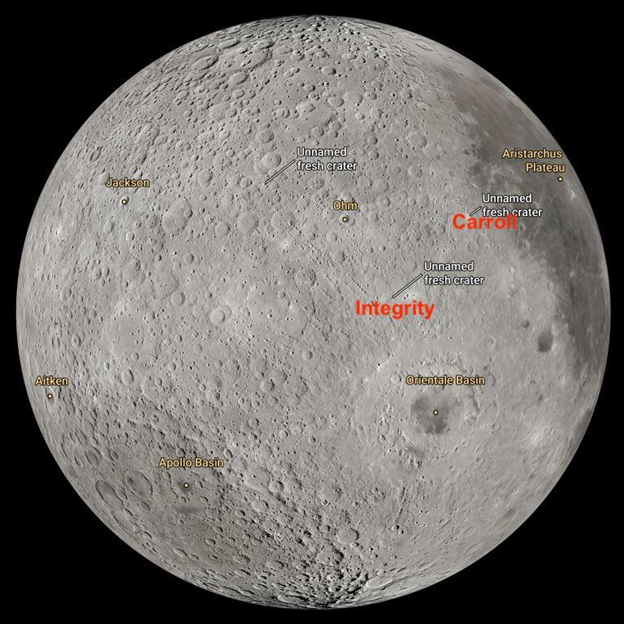
· The crew identified new craters including a large impact crater about 1000km across. The crew named one of these new craters ‘Integrity’ after their capsule and they requested thatanother be named after Commander Wiseman’s wife, Carroll, who died in 2020. It was an emotional moment shared with the world.
· The crew saw six tiny meteorite impact flashes during the solar eclipse as they flew over the far side. This was unexpected and has made scientists consider how they might protect a future lunar base from potentially regular tiny impacts.
· Surprisingly, the astronauts could see colours on the surface –greens, browns and greys. This indicates that there are different mineral and chemical compositions in the lunar rock which may mean that explorers could use the rocks to make, say, oxygen or building materials. I always thought the Moon was just greys and whites.
I am sure there will be many more new findings to emerge from the mission. Can’t wait to hear about what else they learned!
A final note:
Oh, I forgot – there was an additional crew member!
Meet RISE, the specially designed zero-gravity indicator who accompanied the crew on Orion. Inside Rise was an SD card containing over 5 million names of people on Earth who hoped to share in the mission.
Designed by Lucas Ye, a nine-year-old from California (he won the design competition), the little plushie ‘rises’ up in the capsule when the spacecraft reaches microgravity.
Rise was part of all the social media posts and became a much-loved member of the Crew. Commander Riseman actually refused to let him stay on the craft and took him home instead!
Find out more here!
SIDEWALK ASTRONOMY THIS WEEK
Friday 24th April at 6pm just outside the Discovery Centre.
Want to look at the moon yourself? See how many craters you can find?
Join us for Sidewalk Astronomy on Friday 24thApril at 6pm.
The friendly members of the ASV Bendigo section will be setting up their telescopes
outside Discovery in the Marketplace Carpark.
They would love to see you there!
Sign Up To Our Mailing List