In 2018, a plucky little robotic space craft, called BepiColombo, set off on a very long journey to study the smallest planet in our Solar System.
The BepiColombo mission is led by the European Space Agency (ESA) in collaboration with the Japanese Space agency(JAXA), and NASA.
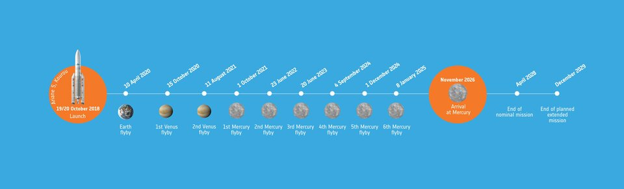
On the 5th of September 2026, BepiColombo began its final approach, before settling into orbit around Mercury in November.
Here is the timeline for the mission:
There have been three missions launched to Mercury over the past 50 years.
In the 1970’s, NASA’s Mariner 10 spacecraft took 147 days to reach Mercury. Mariner didn’t go into orbit – instead, it flew by the planet while it was orbiting around the Sun. We got glimpses of the surface for the very first time. In 2011, NASA’s Messenger spacecraft was the first to orbit Mercury – it took 6.5 years to get there. Messenger sent back lots of data – and raised a lot of new questions!
BepiColombo set off in 2018 – it has taken 8 years to get there. To go into orbit, not just flyby, a spacecraft has to slow down enough to be captured by the planet’s gravity. Think about it. As BepiColombo flies closer to the Sun, the enormous gravity of our star causes the craft to speed up – like it is going downhill without the brakes on. But Mercury is travelling around the Sun at about 170,550kms per hour. It is whizzing around faster than any other planet in the Solar System, only taking about 88 days to go around the Sun.
So it is a tricky challenge – how to go fast enough to match Mercury’s speed, but not so fast that you zoom on by and head into the Sun’s furnace.
For BepiColombo to put on the brakes, it used the gravitational pull of other planets to slow down. This is called a gravity assist manoeuvre and you can use this trick to either slow down or speed up a spacecraft.
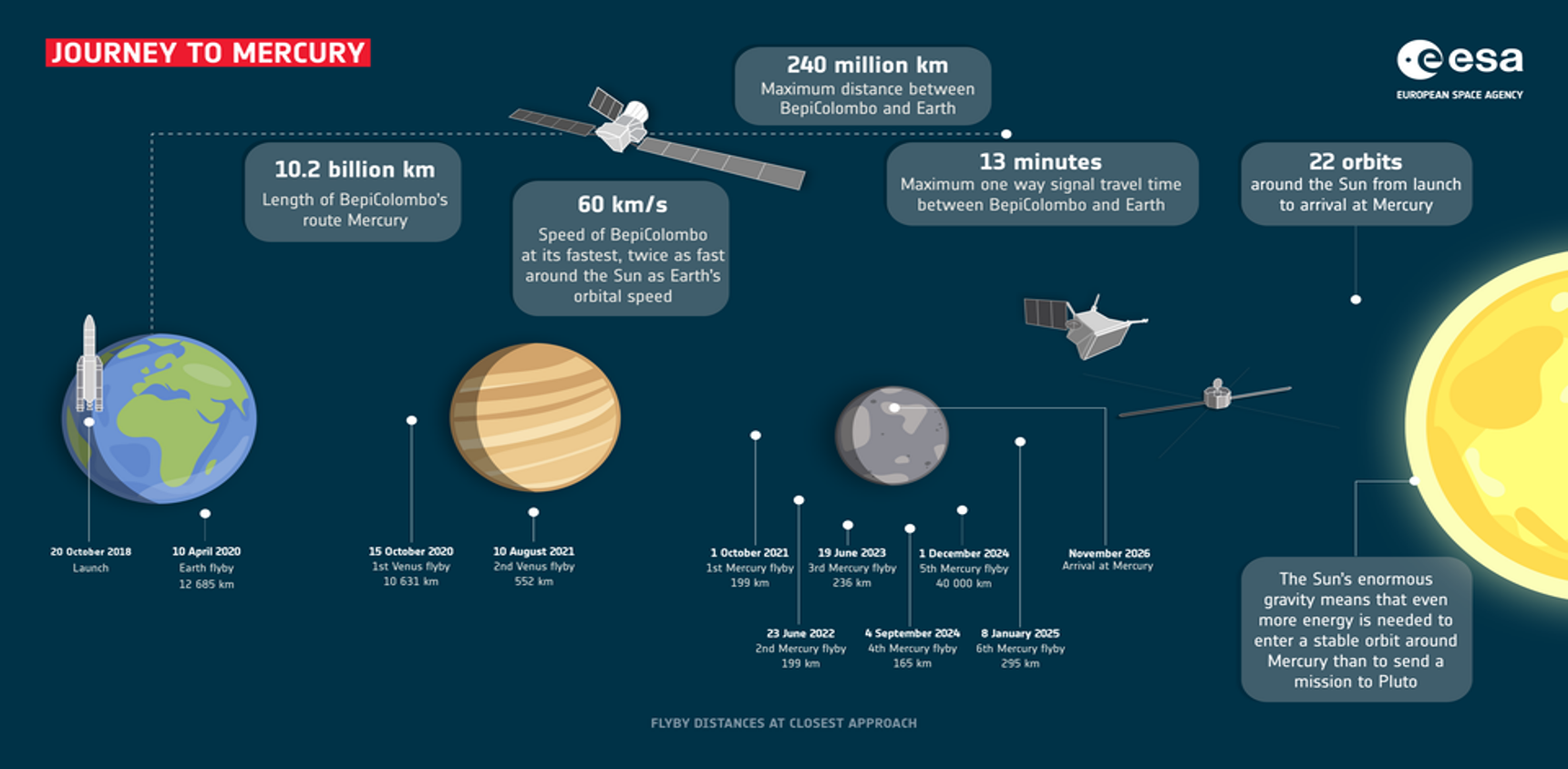
Guiseppe (or Bepi) Colombo worked out the maths to make this clever gravitational slingshot technique work. The ESA spacecraft is called after him because they used his technique to help it get into orbit around Mercury. Over its long journey, BepiColombo used plasma propulsion technology and nine gravity-assist flybys of Earth, Venus and Mercury to get enough energy to fight against the huge gravity of the Sun.
In December, the spacecraft will be travelling at just the right speed to be captured into Mercury’s orbit. Then it will release two orbiter craft -- ESA’s Mercury Planetary Orbiter (MPO) and Japan’s Mercury Magnetospheric Orbiter (Mio). The two orbiters will circle the planet and look for answers to the many questions we have about this odd little planet. The data collection phase will begin in April 2027, when MPO will study the surface of the planet and Mio will focus on magnetic fields, plasma and dust.
Have a look at the complicated journey undertaken by BepiColombo to get to Mercury.
Well .... actually, Mercury is pretty interesting!
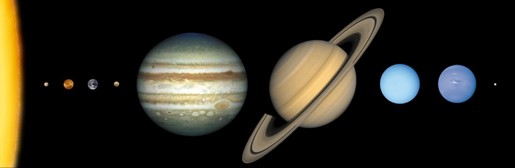
At 4,870 km in diameter, Mercury is the smallest planet in the Solar System. But two moons (Ganymede -- a moon of Jupiter; and Titan -- a moon of Saturn) are both larger than Mercury. Our own moon is just 3,474kms in diameter so it is smaller than Mercury.
You can get an idea of the relative sizes of the planets in this illustration from NASA. See how small Mercury is!
Even though it is the closest planet to the Sun, Mercury is not the hottest. That award goes to Venus, whose thick poisonous atmosphere traps the heat in, meaning that the surface of Venus has an average temperature of 467C!
On Mercury, one day lasts the equivalent of 176 days on Earth. Without much of an atmosphere, Mercury experiences wild swings in temperature -- from a toe-curling 427C during the long day, down to a freezing minus 180C during the equally long night. That would be hard to get used to! Talk about needing to dress in layers!
Mercury might not be the hottest planet, but it is the FASTEST! Mercury whizzes around the Sun at around 47kms per second – it only takes 88 days to do one lap (a Mercurian year!). On Earth, we take 365 days to complete one orbit, travelling at 30kms per second. Because Mercury is travelling so fast, it is really difficult for a spacecraft to match its exact speed and go into orbit.
Talking of orbits, Mercury has an egg-shaped orbit, called an elliptical orbit. At its closest point to the Sun (the perihelion), Mercury reaches around 46 million kms from the Sun. At the furthest point in its orbit (aphelion) it is around 70 million kms away.
Unlike Earth, Mercury is not tilted much on its axis, only 2 degrees -- so it doesn’t really have seasons like we do. Earth is tilted over at about 23.4 degrees from the upright. On the other hand, Mercury kind of stands up straight.
Here is a great animation showing Mercury’s loopy path around the Sun:
In the Solar System, the huge gas giants (Jupiter, Saturn, Neptune and Uranus) are surrounded by a magnetic field. Earth has one too and so does Mercury. True, Mercury’s magnetosphere is only about 1% that of Earth’s, but it is there. This region around a planet acts like a magnetic shield and protects the planet from incoming charged particles like solar radiation. Without our magnetosphere, we would be bombarded by solar radiation and life probably would not have survived.
Usually, a magnetosphere is the result of a molten metal core which is generating electrical currents. The fact that Mercury has a magnetosphere means that it is likely that the planet’s core is made of metal and is probably molten. Mercury is a living planet. Neither Mars, nor Venus, has a magnetosphere, meaning that their cores are no longer active – they are effectively dead.
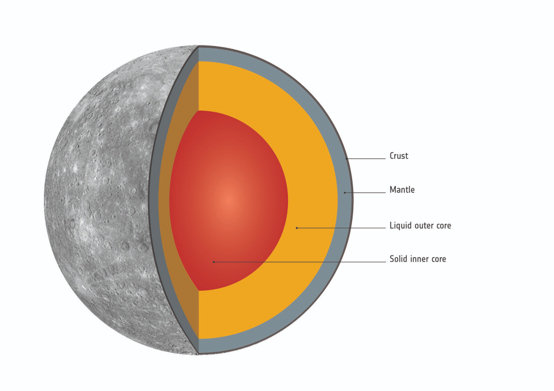
Using data from the Messenger mission, scientists worked out that Mercury’s core is BIG – it takes up about 42% of its volume – Earth's core on the other hand is only about 17% of total volume.
There is evidence to suggest that the outer core is partially molten - which would explain the presence of a magnetosphere. In this illustration from ESA, you can see how thin the crust is, compared to the inner and outer cores.
Mercury’s core has a higher iron content than any other planet in the Solar System. Scientists think that this could mean Mercury was once much larger, but, after it was struck by another large object during the early Solar System shenanigans, much of the crust was stripped away.
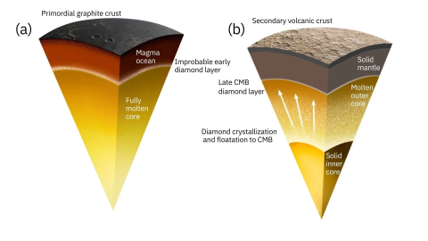
Mercury has what is called a low albedo – it doesn’t reflect sunlight as much as say, Venus or Earth. In truth, some parts reflect light more than others. Because we haven’t actually been to the surface, we have to use very clever techniques from geology to analyse the composition of the crust. From these studies, we have learned that a form of carbon, called graphit, floated on the surface of the magma ocean on early Mercury, forming a thin crust. This has been smashed around a bit by meteors over millennia, but the crust is still carbon-rich with graphite. Graphite is grey and dark in colour, not very reflective.
The actual surface of Mercury is covered in craters from all the meteor impacts over millions of years. Like the Moon.
Some researchers at NASA have wondered whether the extreme heat and pressure, caused by all the impacts on the carbon-rich graphite crust, could have created a layer of diamonds. Diamonds are crystal lattices of carbon atoms, so it is a possibility. One NASA researcher has suggested that there could be a diamond mantle up to 11kms thick beneath the surface. This diagram shows how it could have happened:
Actually, Mercury’s atmosphere is called an exosphere. This thin layer is made up of atoms which are gravitationally bound to the little planet.
We have got an exosphere too -- the very outer layer of Earth’s atmosphere is also made of atoms which are still bound to Earth.
The atoms in the exosphere are blasted off the surface of Mercury by solar winds and meteoroid impacts. There is hardly any air pressure in this wispy layer, which is composed of hydrogen, helium, oxygen, sodium, calcium, potassium, and water vapor.
The air is so thin though it is practically a vacuum. We wouldn’t be able to breathe on Mercury.
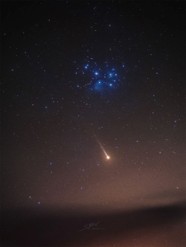
Mercury has a tail made of sodium ions. How can that be? Mercury is not a comet! The tail on a comet is caused when the frozen outer shell heats up as it approaches the Sun and it outgasses to form a tail.
But on Mercury, the thin exosphere contains sodium (table salt is a mix of sodium and chloride). When the exosphere is hit by solar radiation and solar winds, the sodium ions are pushed away from the planet and they form a long tail, which streams away for nearly 3.5 million kms. The sodium atoms glow when they are ionised by the Sun’s radiation.
Here is an image released by NASA’s Astronomy Photo of the Day (APOD) in 2022 showing Mercury’s tail:
The Messenger mission confirmed that there is definitely water ice on Mercury – even though it is so close to the Sun! How is that even possible!
It is thought that there are shallow hollows on the surface which are in permanent shadow – cold enough for ice to be present. Also, water vapour has been found contained in the planet’s exosphere. It is thought that water could have come from asteroids or comets impacting on the planet.
Take a trip around Mercury thanks to NASA here
Observing Mercury from Earth is difficult. Because Mercury is so close to the Sun, it rises and sets almost at the same time as the Sun. It is always close to the horizon and so we can only observe it just before sunrise, or just after sunset. Even powerful telescopes find it a challenge to view Mercury because of the damage which can be caused by the Sun’s rays.
We have talked about how difficult it is to get to Mercury -- it takes a long time and costs a lot of money. We know much more about Mars because it is easier to get there and we can see it more easily.
Being so close to the Sun means that Mercury-bound spacecraft have to be able to cope with very high temperatures and lots of cosmic radiation. BepiColombo has had to use a complex system of space insulation and cooling pipes to help it survive the mission.
What mysteries might BepiColombo help to resolve?
The two orbiters on the BepiColombo mission are tasked with helping us learn more about Mercury. Here is an illustration from ESA showing the main science themes for the mission:
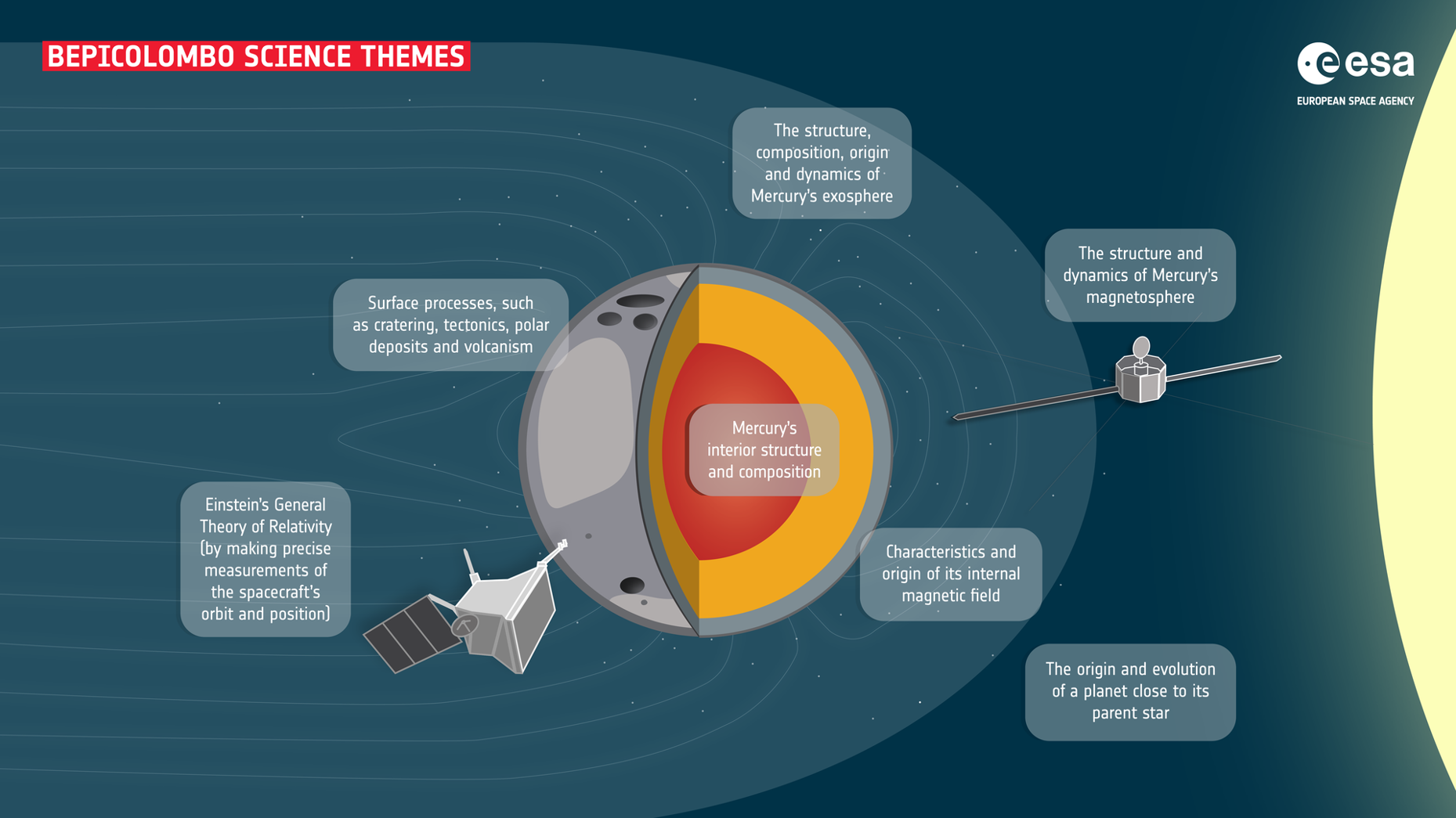
Researchers will be hoping for the orbiters to gather data to help answer some big questions like:
Instruments like radiometers and spectrometers may help understand the mineral and elemental composition of Mercury’s surface. This may give some insight to help us work out where Mercury might have formed. Because of the presence of elements like potassium on the surface, scientists wonder if Mercury might have formed further out near Jupiter and ended up closer to the Sun after being hit by a larger planetisimal.
I know – hard to believe.
Instruments on Bepi’s MPO orbiter will be used to measure water content at the polar regions and try to work out how much might be there.
There are strange hollow regions on Mercury which seem to have formed fairly recently. BepiColombo hopes to determine whether these hollows have been changing which would mean that Mercury is perhaps geologically still active, rather than dead like the Moon.
Some data has also suggested that Mercury might be shrinking – and we don’t really know why.
Mercury only reflects about 2/3rds of the light as what the Moon does. BepiColombo will map the distribution of minerals on the surface to help us understand this better. Is it because of the graphite?
The logical explanation for this would be that Mercury’s core must be partially molten. BepiColombo’s two orbiters will study this magnetic field in greater detail to get more insight into what is going on.
Are you ready?
Don’t know about you, but I can’t wait to find out more about the first rock from the Sun!
The friendly members of the Bendigo section of the Astronomical Society of Victoria will be setting up their telescopes outside Discovery again this Friday.
Depending on whether the clouds behave, we may even be able to glimpse Mercury just after sunset and glorious Venus! Definitely some other stars and constellations too.
See you there – weather permitting!
Sign Up To Our Mailing List