Imagine taking a spaceship to the Sun where the temperature, just on the surface, can reach around 5,500 degrees Celsius. If you had a Sun submersible you would have to cope with up to 15million degrees Celsius. Now I’d call that extreme – what about you?
But actually the Sun is not really that unusual – there are lots of stars like the Sun -- but there are others which are much larger and much hotter.
So what kind of star could we classify as fully EXTREME?
Probably one of the most mind-boggling types of star is called a PULSAR.
Let’s explore why a Pulsar is so amazing and so out there!
What’s a PULSAR?
When a massive star dies, a star that is, say, more than 1000 times bigger than our Sun, it collapses under its own gravity so fast that it explodes into a supernova. This explosion shoots plasma, gas and dust out into space and creates a nebula that we can see through a powerful telescope.
After the supernova calms down, the leftovers shrink down, thanks to gravity, into a very dense core or compact remnant.
This is where things get wild!
The remnant core is super dense, so dense that if it were on Earth, just a teaspoon would weigh around a trillion kilograms. Imagine the gravity of such an object!
Astronomers have found that, depending on how massive the star was, this dense core remnant could become either a NEUTRON STAR or a BLACK HOLE.
Neutron Stars
Let’s stick with neutron stars for the moment.
A neutron star is mostly made of neutrons, subatomic particles that make up atoms along with protons. All the other fuel has burned up. In a neutron star, the neutrons are packed in so tightly that just a tiny amount is super heavy.
A typical neutron star is about 20kms across and has a surface gravity 100 billion times more that earth. You wouldn’t even be able to crawl around under that much gravity. You would be totally flattened.
Neutron stars can generate magnetic fields that are trillions of times stronger than Earth’s, and they spin at hundreds of rotations per second!
EXTREME!!
Here is an artist’s impression of one of these weird stars courtesy of the European Space Agency (ESA).
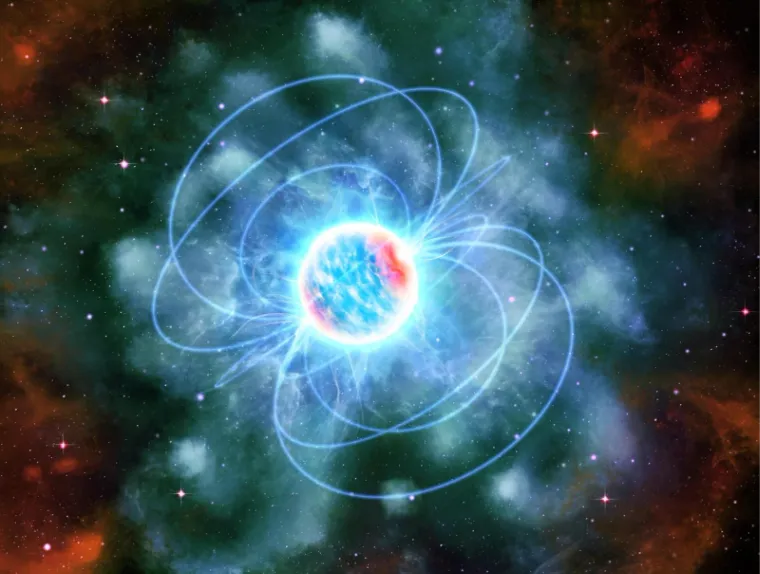
An artist impression of a neutron star, shown as a bright blue and red sphere with spark-like features flying off it. Several blue magnetic field lines loop connect the sphere's two poles. The sphere is surrounded by a see-through blue cloud, and with a red cloud on the sides of the image. Stars are visible in the background.
CREDIT:ICE-CSIC/D. Futselaar/Marino et al.
So why are we talking about neutron stars?
Some neutron stars send out beams of radiation, or radio waves, which radio telescopes on Earth pick up as bursts of radio emissions. These waves are thought to be generated by the very energetic magnetic fields which formed around these ultra dense objects. These waves of radiation sweep out through space like a lighthouse.
As a result, neutron stars send out steady pulses of energy – like a heartbeat on an electrocardiogram (ECG).
We now call these rapidly spinning neutron stars, PULSARS.
Have a look at this clip from NASA to find out more:
https://www.youtube.com/watch?v=gjLk_72V9Bw&t=58s
The Sounds Of A Pulsar
You can listen in to the radio waves sent out by a pulsar --this one was picked up by the Parkes Radio Telescope here in Australia, in collaboration with the Jodrell Bank Observatory in the UK.
https://www.jb.man.ac.uk/research/pulsar/Education/Sounds/0835_seq.mp4
Source: Jodrell Bank Observatory, UK
This pulsar is found in the Vela Supernova Remnant, which is about 900 light years away. A huge star exploded there about 10,000 years ago, collapsing into a neutron star. Since it spins at about 11 times per second, it is called a pulsar.
Do you see what I mean about it being like an ECG?
How Were Pulsars Discovered?
In the mid 1960’s, a young woman astronomer, called Jocelyn Bell, was studying changes in radio emissions from astronomical objects. This flickering is called scintillation – like when stars twinkle as their light passes through space and our atmosphere.
Jocelyn and her supervisor, Tony Hewish, were scanning the sky for radio emissions from space and then analysing the data – which she did by hand, not with a computer!!
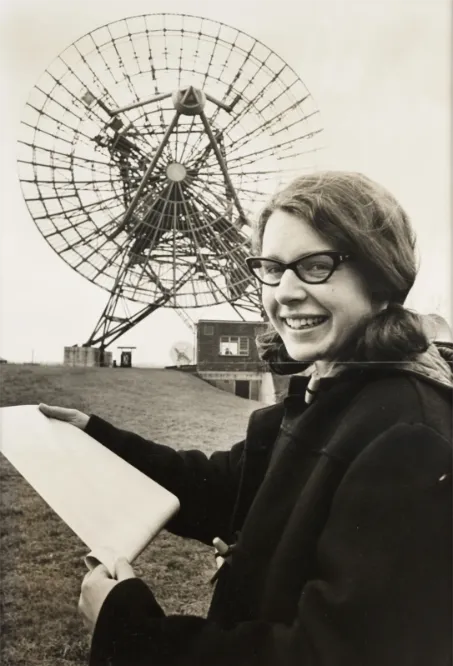
A photograph of Jocelyn Bell Burnell at the Mullard Radio Astronomy Observatory at Cambridge University, taken for the Daily Herald newspaper in 1968. (Image credit: Photo by Daily Herald Archive/National Science & Media Museum/SSPL via Getty Images)
Image address: https://cdn.mos.cms.futurecdn.net/8EhX37AuHcoc4y9Y8avkwF-1200-80.jpg.webp
While she was going through the data, she noticed some sort of ‘scruff’ or interference in the signal. At first the team thought it might be an alien signal (little green men or ET perhaps?). Mysteriously, the signal was ‘pulsing’, repeating at regular intervals.
Jocelyn and the team finally narrowed the signal down to coming from an object which they called a ‘pulsar’ because the radio emission was pulsing. At the time, neutron stars had just been identified as a theoretical object and the pulses were thought to come from one of these objects. She had found the first pulsar!
Jocelyn’s supervisor, Tony Hewish, was awarded a Nobel Prize for this groundbreaking work. However, these days Jocelyn Bell is regarded as the person who discovered pulsars.
Over 3000 pulsars have been found so far. The new Vera Rubin Observatory is likely to find even more as it maps the southern night sky.
Why Are Astronomers So Excited About Pulsars?
Well, I’m excited about Pulsars – what about you?
Don’t Forget!
It’s time for:
Sidewalk Astronomy – Friday 27 March at 7.30pm outside the Discovery Centre
Come join the friendly and knowledgeable people from the Astronomical Society of Victoria, Bendigo Section in the Marketplace Carpark on Friday 27th March.
They will bring their telescopes to share so you can gaze in wonder at the night sky (clouds permitting!!)
We have to have a radio telescope in order to see pulsars 😞, but we might be able to see some supernova remnants where pulsars could be hiding!
Sign Up To Our Mailing List