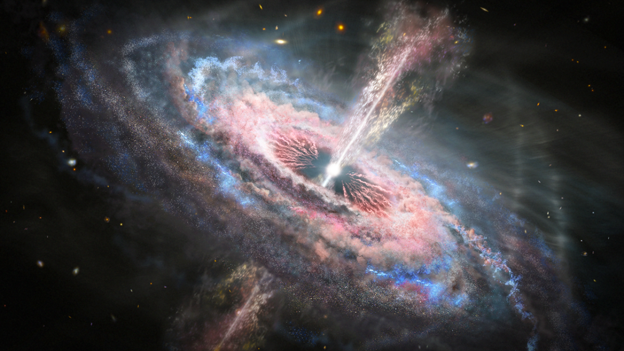
Extreme Galaxies: Quasars and Blazars!
We have talked before about very extreme stars called Pulsars – remember those spinning, super-dense neutron stars that send out pulses of radio waves into the Universe.
Now we are going to talk about some other extreme objects pouring out of the heart of galaxies!
These objects are so bright, they outshine all of the stars in their home galaxy-- they can shine 100,000 times brighter than our Milky Way galaxy. Lucky they are a long way away or we would be blinded!
These phenomena are called Quasars and Blazars, and astronomers didn't know what they were when they first saw them. Because they were mysterious points of very bright light, they were originally called 'radio stars'.
What are quasars and blazars?
Actually, quasars and blazars are versionsof the same phenomena.
They are both generated by very active, giant black holes at the centre of a galaxy.
When a powerful black hole is in a very active state, it sucks up huge amounts of dust, gas and stars from its immediate surroundings. In fact, it is gobbling so much stuff that everything falling towards the black hole, all the dust, gas and stars, ends up forming what is called an accretion disk.
This disk is spinning around the hole at breakneck speeds. We can't see the actual hole of course, but we have been able to see, and even image, the accretion disk around two black holes including the one at the centre of our galaxy, Sagittarius A*. When the black hole in the centre of an accretion disk, is devouring the dust, gases and stars in the disk, we say that it is an ACTIVEGALACTIC NUCLEUS or AGN.
The AGN makes magic happen!
Accretion disk material gets sucked in bythe enormous gravitational force of the supermassive black hole. The accretiondisk material speeds up as it spins around the Black Hole. It gets accelerated somuch that it reaches speeds which are close to the speed of light (relativisticspeeds). The material heats up. It glows. It shoots out plasma jets that can bethousands of light years long. These jets pour out radiation and light into theUniverse.
We are able to see the intense electromagnetic radiation ejected by these objects through powerful telescopes and radio telescopes. We can see it across the entire electromagnetic spectrum, from long radio waves to ultra short gamma waves (depending on which telescope we are using).
Quasars are accelerators
These jets are moving fast.
Here on Earth, we have built some particle accelerators designed to speed them up so that we can learn more about how they interact (like the Large Hadron Collider at CERN). Particle accelerators are used not only to explore the mysteries of the Universe, but also to understand more about how nuclear physics works, finding ways to protect astronauts and spacecraft from space radiation, developing radiation therapies in medicine, and even authenticating an artwork or museum piece.
But Quasars are at another level. Quasars (and Blazars) are the LARGEST particle accelerators in the whole Universe, spitting out particles moving at light speed!!
Quasar or Blazar – depends on how you look at it
Both quasars and blazars are powered by Active Galactic Nuclei – which are fueled by a supermassive black hole at the centre of a galaxy. These black holes can be millions and even billions of times the size of our sun.
Quasars send out super luminous jets of plasma which are visible across the whole electromagnetic spectrum.
What you call these objects depends on the pointof view of the observer.
If the plasma jets are pointing directly at Earth, it is called a blazar, because it is so bright. If the jet is slightly, but not directly, angled towards us, it is a quasar. If the jet is shooting straight up, not at us,it is called a radio galaxy.
Robert Anonucci from the University of California has been studying the behaviour of Active Galactic Nuclei and developed a model showing how quasars and blazars are seen differently by observers.
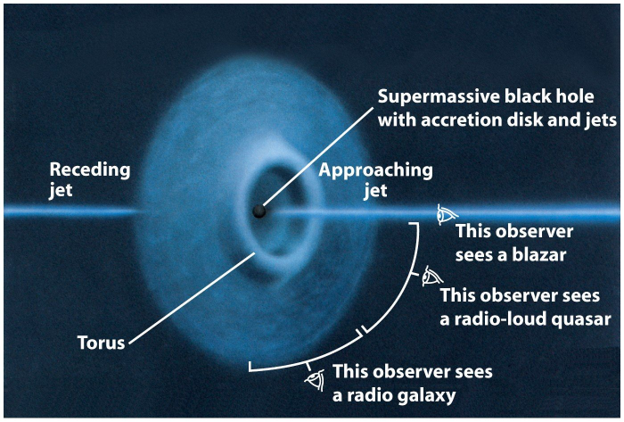
And here is a video explaining thedifference between a quasar and a blazar.
How were quasars and blazars discovered?
The very first quasar was identified in 1962 by Maarten Schmidt. Our very own Parkes Radio Astronomy Telescope (The Dish) played a role in this discovery.
If quasars and blazars are so bright, you might wonder why we didn't know about them before 1962.
The truth is that, before the 1920's, we didn't know that there were other galaxies out there at all. Edwin Hubble was the first to prove that spiral nebula, which could be seen from Earth, were actually located far beyond the Milky Way – they were not clouds of stars, they were individual galaxies, quite separate to the Milky Way.
So when Edward Fath described a nuclear emission coming from what he thought was a cloud of stars in 1908, he didn't know what it could be. But Edward noticed that these objects were very bright and very active.
We learned more after the development of radio telescopes, when astronomers found that stars emitted radio waves. But even in the early sixties, it was thought that the powerful emission lines coming from a galaxy, must have been what people were calling a 'radio star'.
Slowly, astronomers determined that, not only were these emissions very strong, they were coming from the very centre ofgalaxies. They were galaxies – not stars!
The emission lines astronomers found are 'red shifted', meaning that they were coming from VERY far away. In fact, they were coming from way back when the Universe was very young.
Originally the objects were known as 'quasi–stellar radio source' – like a star. This has since been shortened to 'quasar' now that we know that they are not 'like a star'!
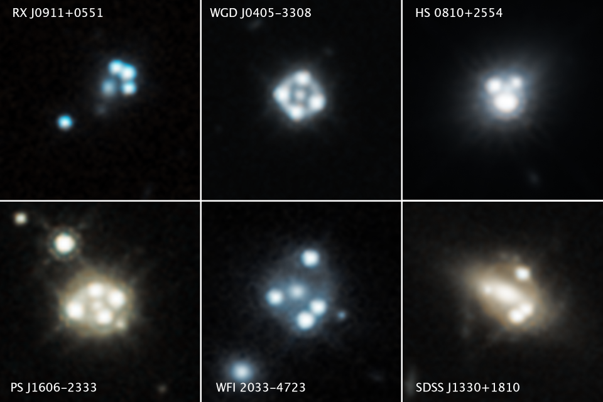
The Hubble Space Telescope helped astronomers to find many of these powerful points of light coming from galaxies far, far away.
Here is an image of some of the quasars imaged by the Hubble Space Telescope using a technique called gravitationallensing to help see the distant but bright objects:
How many quasars have been discovered?
Since the first quasars were discovered,astronomers have catalogued thousands of quasars and blazars. Blazars are rarerbecause they have to be pointing theirjets directly at us.
With AI's help, here is the current tallyof quasars and blazars discovered so far.

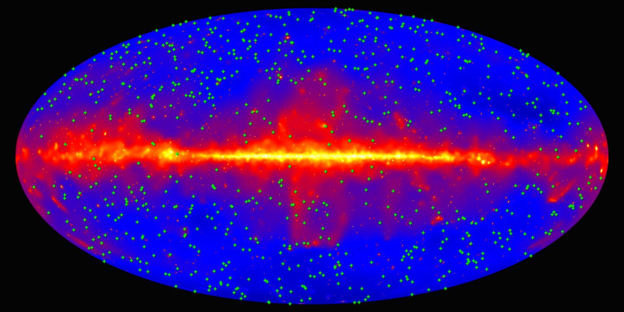
You can get an idea of how blazars are sprinkled across the night sky by looking at this map of 739 blazars, imaged by the Fermi Gamma Ray Space Telescope over 9 years of observations.
How about these quasars/blazars!
These objects are AMAZING – as Rocky from Erid would say 'Amaze! Amaze! Amaze!

Some amazing facts about quasars and blazars:
· Quasars and blazars are some of the very brightest objects in the Universe
· Quasars and blazars are NOT stars – they are a type of galaxy
· A quasar, or a blazar, is an Active Galactic Nucleus (AGN) -- shooting out a stream of particles from a supermassive black hole at the centre of a galaxy
· Quasars are the biggest particle accelerators in the Universe – they speed up particles in the jet streams to almost the speed of light – faster-than-light travel!
· The difference between a quasar and a blazar is simply to do with the way its jets are angled towards us
· The supermassive black hole (Sagittarius A*), at the centre of our own galaxy, may have once been a quasar --but it is currently pretty quiet thank goodness!
· The nearest quasar to Earth is Markarian 231, in the constellation of Ursa Major (click here to have a look at Markarian 231)
· The light from quasars is ‘red-shifted’ meaning that their light has travelled for billions of years, probably from when the Universe was very young
· Quasars are thought to be generated in the early, very active, stages of a galaxy’s life
· The very first quasar was discovered in 1962 – and our own Parkes Radio Telescope helped with this discovery
· The brightest and hungriest quasar, called JO529-4351, is 500 trillion times brighter than the Sun and is 12 billion light years away from us. Discovered in 2024 by the ESO’s Very Large Telescope (VLT), it is the fastest growing quasar ever recorded and is the brightest object in the known Universe!
I don't know about you, but I am totally inawe of these amazing objects and can't wait to find out more about what makesthem tick!
TIME FOR SIDEWALK ASTRONOMY AGAIN
On Friday, the knowledgeable crew from the Bendigo Section of the Astronomical Society of Victoria will be setting up their telescopes in the Marketplace Carpark, just outside the Discovery Centre.
Date: Friday 16th October
Time: 8pm
Where: Bendigo Marketplace Carpark, near the Discovery Centre
Depending on the weather, ASV members will help you look up close and personal at the Moon, Venus, maybe Saturn and beautiful star clusters.
Come along and wonder at the sky!
Sign Up To Our Mailing List