What gives a star its colour?
In the image above, taken by the Hubble Space Telescope, lots of stars look white but there are also many red stars (well, pinky-orangey-red), and ones that look blue.
What is the difference between these stars?
Astronomers have found that these colour differences are not random. The colour of a star mainly depends on how HOT it is – its surface temperature.
The very HOTTEST stars look blue. The temperature on their surface can be up to 49,000o Celsius. Phew! Blue stars are usually HUGE young stars – they are called blue giant stars. There is a blue giant, called Rigel, in the constellation of Orion which is visible in our summer sky.
The COOLEST stars, at around 3,400 o Celsius, look red. How weird is that – blue for hot and red for cool!! There is a red giant star, also in Orion – called Betelgeuse.
Our Sun has a surface temperature of about 5,500 o Celsius, so it is on the cooler side and so it looks yellowy- white.
Every object with a temperature above absolute zero emits electromagnetic radiation -- a type of energy that travels in waves of different lengths, like radio waves, infrared, ultraviolet and microwave waves. These different wavelengths can be captured using a diagram showing an object's electromagnetic spectrum. We can learn a lot about an object, like which elements are present and how hot it is. Stellar spectra are important tools in astronomy and help us understand more about individual stars.
As a star heats up, its colour changes. Because of this, astronomers found a way to classify stars according to their colour and temperature.
The Classification of Stars
Colour and temperature differences helped astronomers to classify stars into categories.
This table shows you how stars can be classified according to their colour and their temperature.
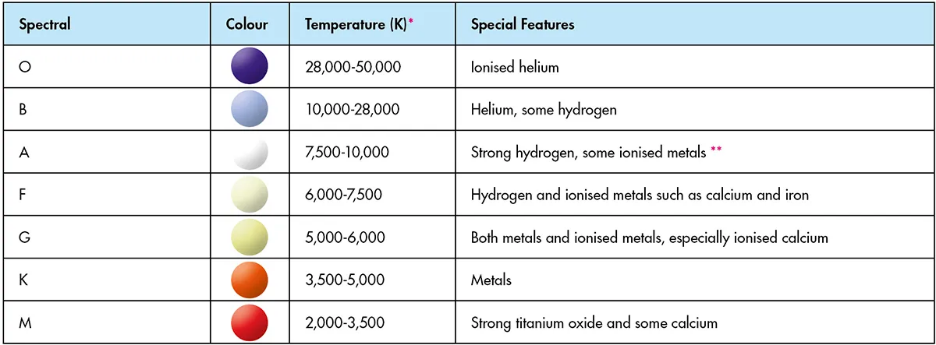
If you remember, we just found out that our Sun has a surface temperature of 5,500o Celsius. Astronomers measure the temperature of stars in Kelvin (K). To convert Celsius to Kelvin , you add +273 to whatever the temperature is in Celsius. Our Sun's temperature in Kelvin would be 5,500 o C + 273 = 5,773K.
So, using the table above, what do you think the spectral class of our Sun would be?
Yes, our star is a G type star – and it is yellowish-white in colour.
Hey -- maybe there could be even more star colours!
According to the table of classifications, stars can be red/orange, white/yellow and shades of blue.
Now, we are learning that some stars don't play by the usual rules – they can come in range of different colours that don't just depend on temperature.
But not just any stars.
Researchers at the University of Warwick (UK) were interested to find out what a special kind of star, a white dwarf, might look like if we could get close enough to see their true colours. Are they all really white?
What in space is a white dwarf?
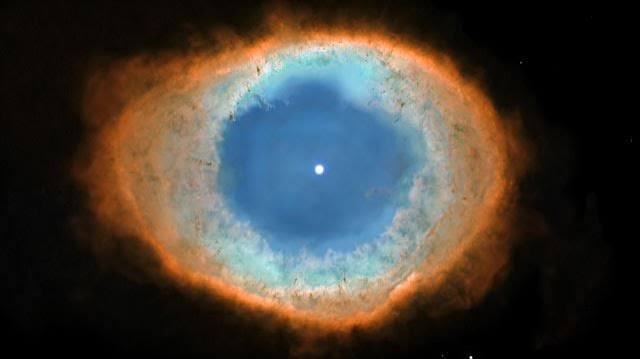
White dwarf stars are the super dense remains of a sun-like star, after it reaches the end of its fuel burning life. As these stars die, they swell up, the lighter elements blow away and the heavier elements shrink down to form a small, very dense core -- a white dwarf. The lighter gases and dust appear like a giant colourful bubble around the central star. This bubble is called a planetary nebula (because they look round).
Since the remnant cores of these stars are very faint and small, they look white to us, which is why they became known as white dwarf stars.
You can see the tiny white dwarf in the centre of this image of the Ring Nebula, taken by the Hubble Telescope, It looks white to me! What do you think?
What! Maybe not all white dwarf stars are white!
White dwarf stars are so far away and so faint that we are not able to 'see' their true colour with our human vision.
The research team at Warwick University studied the light emitted from 151 white dwarf stars which varied in temperature, composition and density.
To find out how they might look to us, the team examined each star's spectra - the fingerprint produced when light is split into wavelengths through a kind of prism (like a rainbow). The spectra were then fed through a model of human colour-vision to find out how the stars would appear to our eyes –to get an idea of the stars colour as we would see it.
The result was VERY surprising!
In the words of one of the researchers, Dr Mark Hollands:
"It turns out these incredibly dense stars can produce colours nobody expected – and some of them genuinely surprised me"
According to the team, the density of these little stars can cause any trace elements present, like calcium, carbon, or sodium, to interact with the surrounding plasma and so absorb light across a kaleidoscope of colours -- many more than you would expect.
Actually, most of the white dwarfs they studied would look white to us. Of the 151 they examined, five of the stars showed unusual colouring. That's about 3%.
First ever Green Star Discovered!
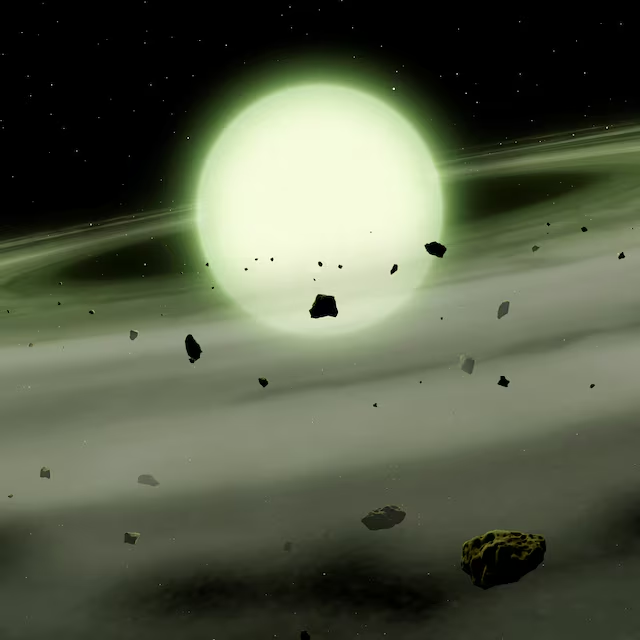
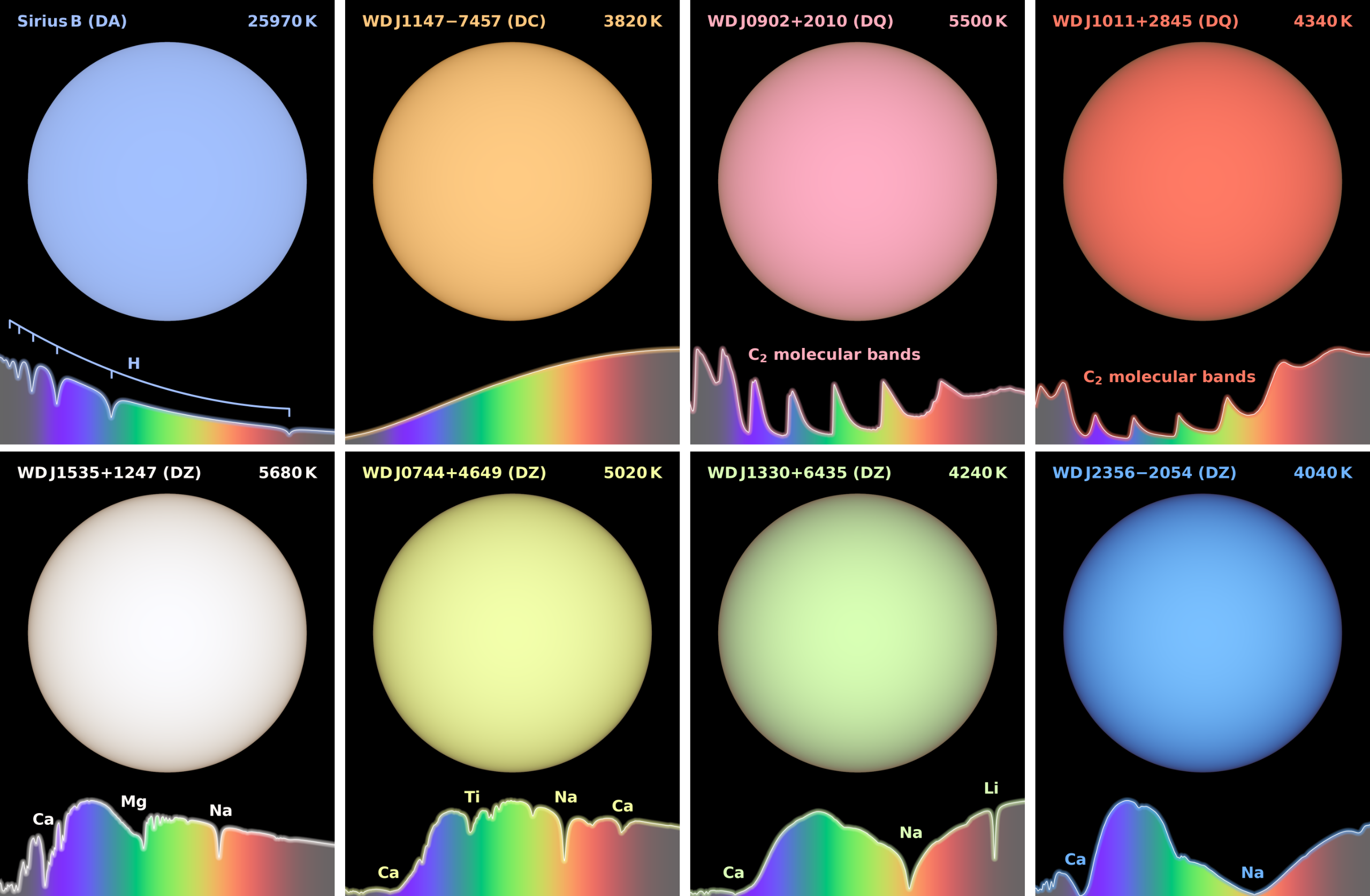
A little cool white dwarf, called WD J1130+6435, located about 326 light years away, was found to appear a ghostly GREEN in colour! Creepy!
Here is how the team think it might look.
Woooooooo.
It is thought that, as this star was dying, it gobbled up planets and asteroids which had been minding their own business orbiting the star. This rocky dinner enriched the atmosphere around the white dwarf with calcium, lithium and sodium. Sodium, in particular, absorbs a range of yellow, orange and red wavelengths, leaving behind an eerie green glow.
Can you imagine what it would be like to look up and see a GREEN sun? What would other colours look like? Would we look green?
I loved this little video which asked the very same question!
Some estimates suggest that there could be up to 10 billion white dwarf stars in our galaxy. That means there could be hundreds of thousands of green stars out there!
Discovery of the reddest star!!
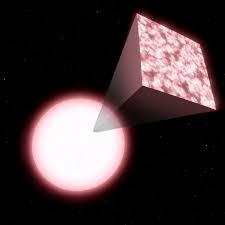
The team also found what they think is the reddest star ever found – WD J1011+2845.
This white dwarf is coated in carbon which distorts the light resulting in a deep salmon-pink colour unlike any other.
All the colours of the rainbow!
Here is a set of colour-accurate, simulated images showing the full colour variation the team found might be possible in white dwarf stars.
Definitely not all white after all!
IT'S TIME FOR SIDEWALK ASTRONOMY AGAIN!
This Friday, the knowledgeable and friendly members of the Astronomical Society of Victoria will bring their telescopes to help you look up at the moon, planets and stars.
When: Friday 20th November at 8.30pm
Where: Bendigo Marketplace Carpark just outside the Discovery Centre
White dwarf stars are too faint to see from Earth, but we might be able to see a planetary nebula with the faint glimmer of a white dwarf in the centre!
There is also another very red star in the Southern Coss – a carbon star called Ruby Crucis. Worth a look?
And of course, we will be able to see the Moon, Saturn and the globular cluster, 47 Tucanae.
Weather and clouds permitting as always!!.
See you there!
Sign Up To Our Mailing List