Last time we all got pretty excited as we watched four astronauts take off in the Orion Spacecraft to complete a lap around the Moon -- for the first time in over 50 years! Those lucky Astronauts were able to see the far side of the moon with their own eyes. WOW!
NASA’s Artemis Project aims to land humans on the moon by 2030 at the latest. We are holding our breath!
We were very lucky to head north earlier this month. We went to central NSW to have a look at a telescope which helped to track Orion’s journey – the famous radio telescope at Parkes, fondly known as ‘The Dish’.
You can see why people call it The Dish when you look at this image which I took last week.

What is The Dish?
Murriyang, the Parkes Telescope is a radio telescope, built to receive radio signals from outer space. Murriyang is part of CSIRO’s Australia Telescope National Facility (ATNF).This 60 year old telescope is now on the National Heritage List.
The Dish is one of the largest single-dish astronomical telescopes in the Southern Hemisphere measuring 64 metres across. Murriyang started operating in 1961 but it has had a lot of upgrades – to its surface, control system, receivers, focus cabin, computers and cabling. It is still at the cutting edge of radio astronomy and is now about 10,000 times more sensitive than when it first started operating in 1964.
Hmmmm – so what is Radio Astronomy and how is it different from ordinary astronomy?
When the first astronomers looked at the stars, they used their eyes to observe light coming from stars, planets and other celestial objects. The invention of the telescope meant that we could see further and more objects.
But visible light is not all there is too observe.
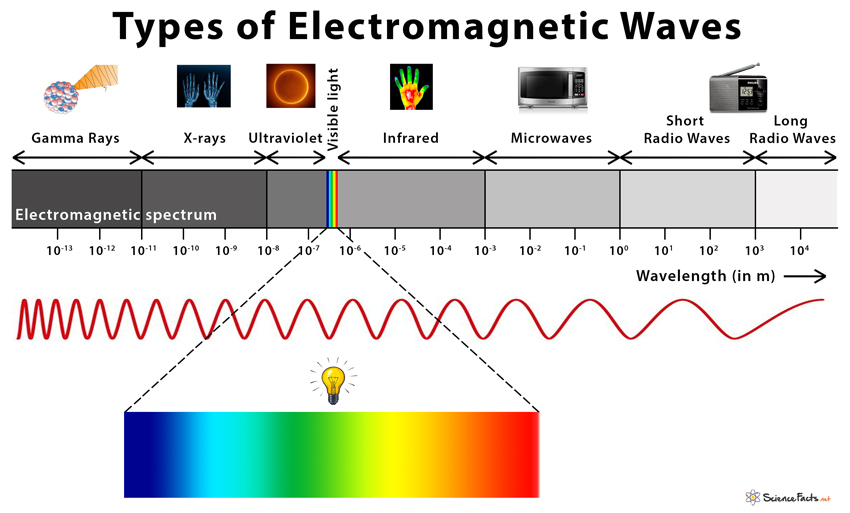
We know that every object ‘emits’ their own pattern of energy waves which travel throughout the cosmos. These waves of radiation vary in frequency and length. Radio waves are part of what is called the electromagnetic spectrum. For example, gamma rays are high energy waves which are very short and very fast. Radio waves are much longer and slower. All of these different wave lengths travel through space at the speed of light.
This picture shows the full electromagnetic (EM) spectrum. We can only see a very tiny portion of the EM spectrum, so we must be missing out on a lot of stuff hey?
Radio Astronomy is born!
In 1931, an American engineer called Karl Jansky, discovered radio waves coming from the Milky Way while he was checking out the cause of static disrupting transatlantic radio communications. He built a big antenna and heard radio signals coming from the centre of our galaxy. Astronomers quickly realised that these radio waves could help them understand and learn much more about the cosmos.
Have a look at this little video put out by your scientists at the CSIRO which explains more about radio astronomy.
https://www.youtube.com/watch?v=duVvbDxW7Sw
How does the Dish work?
Murriyang is like a giant satellite dish which points towards the sky and captures radio waves emitted by objects in space. When the dish collects the waves, it reflects them towards a receiver at the focal point of the dish. Large dishes like Murriyang can capture signals from very far away.
The radio waves are converted into electrical signals which can then be processed into images or graphs which astronomers are able to read and interpret.
The Dish and the Moon
Have you ever had the chance to watch an Australian Movie called ‘The Dish’?

The movie tells the story of the part played by the radio astronomers at Murriyang during the Apollo Mission when humans first walked on the Moon in July 1969. The Dish was a prime receiving station for the Apollo 11 mission and played an important role in receiving video footage of the first Moon walk.
During the recent Artemis Mission,Murriyang again played a role in tracking the spacecraft on its journey towardsthe Moon.
You can see radio astronomer, John Sarkission, hard at work keeping an eye on the Orion spacecraft in the image below.

The discoveries keep on coming from the Dish
She may be old, but boy is she still a cracker!
Here are some of Murriyong’s discoveries which have increased our knowledge and understanding of the Universe.
· Observations from Murriyang played a crucial role in figuring out the true nature of quasars – very bright distant galaxies powered by supermassive black holes which shoot out streams of highly energetic particles.
· Murriyang has discovered more than 1200 pulsars. Remember our blog a couple of months ago where we exploredthese extreme stars? In 2004, the Dish found a double pulsar -- two of these dense spinning objects orbitingeach other.
· The Dish has found hundreds of new galaxies.
· Astronomers at Murriyang found the Magellanic Stream – a giant cloud of gas arching around our galaxy which is over 300,000 light-years long
· Fast radio bursts were found in the telescope’s data archive – we are still busily learning about these mysterious millisecond-long flashes of energy.
If you ever get a chance to visit the Dish at Parkes DO! It is amazing and it is doing fantastic science!
Sidewalk Astronomy is on this week
Join the friendly members of the Astronomical Society of Victoria as they point their (optical) telescopes towards the night sky on:
Friday 22nd May
At
5.30pm
Outside Discovery in the Marketplace Carpark (weather permitting)
We won’t be able to see radio waves, but we can see planets, stars and constellations.
What’s not to love!
See you there
Sign Up To Our Mailing List