If an alien asked you for your address what would you say?
Would you just recite your house number, street and town?
Think about it -- if the alien was from thousands of light years out in space, would that address help them to find you?
Hmmm.... you might want to tell them something like -- which planet you live on; around which star; our place in the Solar System; in which galaxy; in which group of galaxiesetc etc. Phew – it would be hard to fit that onto an email or an envelope!
We are galactic beings. Our Sun and our planet are part of the Milky Way Galaxy – a spiral collection of stars, dust and gas held together by gravity.
Here is an artist’s impression from NASA showing where we fit into the Milky Way:

Can you find us?
If you would like to learn more about how we figured out our address in the Milky Way, have a look at this interesting video from The Secrets of the Universe (SOU).
What kind of galaxy is the Milky Way?
The Milky Way is just one of trillions of galaxies in the Universe. Get your head around that!
There are different kinds of galaxies – yes, they are diverse, just like we are.
Since we live deep inside the Milky Way, itis really hard for us to see the whole thing. So how can we know what it looks like?
Think about a dinner plate or a disk. You have to look down from above, or up from below, to see the plate as a circle. If you look side-on, you can only see a thick line -- you can't see the whole circle. That's why, when we look up at the dark night sky, especially during winter in the Southern Hemisphere, the Milky Way looks like a river or stream across the sky. Ancient cultures thought so too, describing it as a watercourse, river or pathway.
We now know that it is not simply a thick line of stars, it is actually in the shape of a spiral.
Astronomers figured this out by noticing where stars are congregated and how they are moving (their velocity). They concluded that the Milky Way is probably disk-shaped, with a bulge in the middle. The motion of the stars told them that the galaxy rotates, or spins around this central bulge, the same as other spiral galaxies we could see with powerful telescopes
The real breakthrough came with the development of infrared telescopes, like NASA's Cosmic Background Explorer (COBE) satellite, which could take images in infrared wavelengths -- invisible to us. Those images clearly showed the edge of the disk with a central bulge and helped astronomers work out the size and shape of the galaxy. Have a look at this image from NASA:
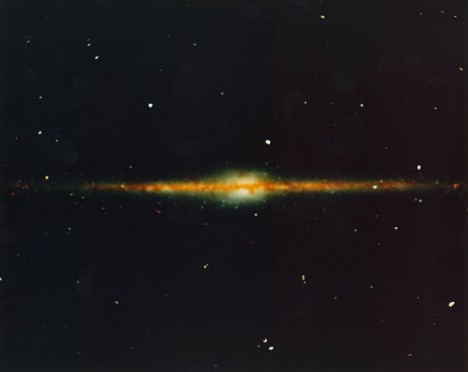
Recent findings have shown that the Milky Way is not really a flat disk -- it tips up at one edge and down at the other. The cause of this wobble is still being investigated, but data from the GAIA space telescope suggests that our galaxy has a giant wave rippling outwards from the centre. Current thinking is that this wave is left over from a previous collision with a smaller dwarf galaxy, but the actual cause is still uncertain. Watch this space!
Astronomers used to think that there were four main arms in the spiral, but data from the Spitzer Space Telescope indicated that there are not four but two main arms coming out from the central region (called Scutum-Centaurus and Perseus).
These two major arms contain millions of old and young stars. Between these main arms are several, less distinct, minor arms and spurs, which are mostly filled with gas and star forming regions. We live on one of these minor arms called the Orion arm. Astronomers now think that our Sun migrated from the centre of the Milky Way, together with many other Sun-like stars, billions of years ago. That meant we ended up in a much quieter region of the galaxy which was perhaps more friendly to the evolution of life.
Across the central region of the Milky Way s a thick bar of very densely packed stars.
So we can describe our galaxy as a barred spiral galaxy – it has arms full of stars that radiate out from the centre ;it has a bulge in the middle and a bar across the central region. The wholegalaxy is surrounded by a spherical, or perhaps football-shaped, 'halo',containing lots of dark matter and some very old stars and star clusters.
Our galaxy is located within a group of about 130 others, including the Andromeda Galaxy, called the Local Group
The Milky Way is ancient – about 13.6 billion years old, not much younger than the Universe actually, which is about 13.8 billion years old.
It is a dynamic place, always changing. It is on the move, travelling through space at around 2.1 million kilometers per hour.
There is considerable evidence to indicate that the Milky Way has collided with a number of smaller galaxies in the past, and we are probably going to merge with the Andromeda Galaxy in about 4-5 billion years.
It's hard for us to imagine the size ofthings in our Universe.
One light year is the equivalent of 9.46 trillion kilometers -- that's a lot of steps.
But get this --the Milky Way is at least 100,000 light years across (and latest research says it may stretch out even further). Imagine – even if you could travel in a spaceship at the speed of light, you would have to be in deep sleep for one hundred thousand years. Gulp!
When we look up at the Milky Way, we can only see a few thousand individual stars (much less if you live in an urbanarea). That feels like a lot when you look up.
The Milky Way is actually home to between 100-400 BILLION stars. We know this because there have been several surveys of the Milky Way, including:
· GAIA (https://www.esa.int/Science_Exploration/Space_Science/Gaia_overview)
· VISTA (https://www.eso.org/public/images/eso1242e/)
· NASA has recently announced that the new Nancy Grace Roman Telescope will begin gathering data on the plane of the Milky Way in 2027. https://www.nasa.gov/missions/roman-space-telescope/journey-to-center-of-milky-way-with-upcoming-nasa-roman-core-survey/
We are learning a lot about our home galaxy through these surveys.
If most stars have planets – that's a lot of possible worlds to explore. There could be billions! So far, we have found about 6000 exoplanets in our part of the Milky Way -- I reckon there must be many millions more. What do you think? And could there be intelligent beings on any of them – who knows?
Most large galaxies have a supermassive black hole in their centre. Some of these black holes are furiously active, spewing out jets of radiation that light up their host galaxy (these very active black holes are called quasars).
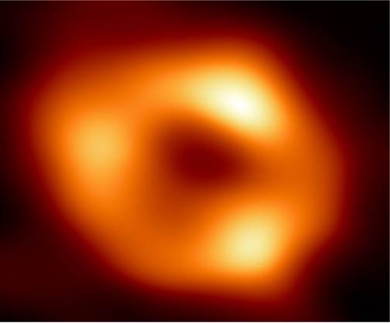
Our galaxy does have a supermassive blackhole at its centre called Sagittarius A* (pronounced Sagittarius A star). It is about 400 million times the size of our Sun.
We live about 27,000 light years away from Sagittarius A *.
We are still learning about the Milky Way's black hole. Compared to some, Sagittarius A* seems to be eerily quiet, but some recent research has found evidence that it is gently breathing out warm gas winds. These winds pump energy into the galaxy, fostering and regulating star formation while maintaining balance in our galactic evolution. It is thought that black holes have periods of high activity and times when things are quiet. Our black hole is in one of its down times.
Here is the first picture of Sagittarius A* captured by the Event Horizon Telescope (EHT) in 2022.
We certainly have lots more to learn about our home galaxy, but let’s finish with a time lapse from Corin Dam near Canberra, taken by Damir Maksan and featured in an ABC article in 2024:
If you are interested in learning how to identify galaxies yourself, have a look at NASA’s Citizen Science Project called Galaxy Zoo -- see here:
https://www.zooniverse.org/projects/zookeeper/galaxy-zoo
You can join in and make your own contribution to astronomy!
When: Friday 24 July at 6pm
Where: Marketplace Carpark just near the Discovery Centre
It is time for your favourite catch up with the members of the Astronomical Society Victoria (Bendigo Section).
We may not be able to see the full magnificence of the Milky Way because of light pollution, but we might be able to see Venus, the Southern Cross, the Omega Centauri and the M4 globular clusters and the stunning Jewel Box open cluster.
Come look through our telescopes (weather permitting of course) and ask questions!
Sign Up To Our Mailing List