If you look around on Earth, human beings seem to leave rubbish and litter all over the place. We create rubbish wherever we go. Wrappings, takeaway containers, plastic cups and bottles, straws ... the list goes on.
Parents and teachers tell us to pick up after ourselves, to recycle whatever we can, and to think about what we put into landfill.
Now that humans are starting to get out and about in Space, what do you think happens to all the junk they take with them? How can humans keep Space clean and tidy?
You might think that there is SO much Space, that a bit of junk won't matter much.
But think about it. Humans have started putting a lot more stuff into Space – like rockets and satellites. What happens to all the left-over bits and pieces? If you have watched a rocket launch, you will know that parts of the rocket get discarded after take-off.
Is any of that stuff biodegradable? Are there any Space bins? Has anyone got a job as a Space cleaner? Should we be worrying about it?
Space debris, or Space Junk, includes all the artificial objects (usually made by humans or AI) which are no longer working but are still in orbit or entering the atmosphere. These objects could be the discarded stages of rockets, released instrument covers or shrouds, engines ejected in the upper atmosphere, debris caused by a collision or explosion, deliberately destroyed satellites or satellites which are no longer working but still in orbit.
This image below is from the European Space Agency, showing the sorts of rubbishy things that are circling around the Earth.
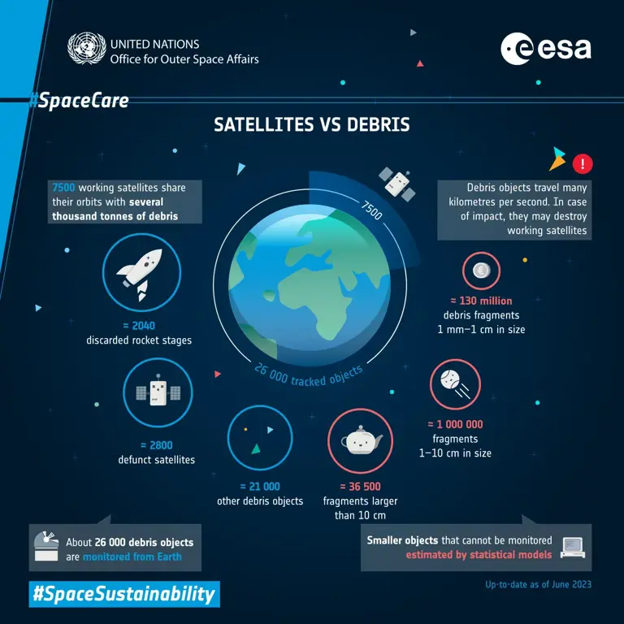
Space junk isn't just messy; it poses a genuine threat to satellites, rockets, astronauts and to us here on Earth. The Space Industry and governments here on Earth are beginning to sit up and take notice.
As a result, several monitoring projects have started up which are specially designed to keep an eye on all these bits of space debris.
This video, produced by Mini Leviathan, talks about some of these space debris tracking projects. You can look them up yourself if you like.
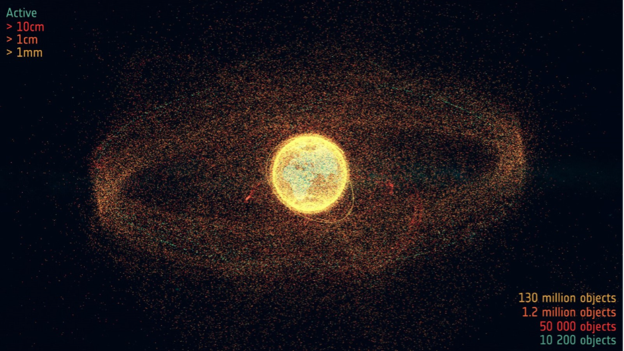
To get an idea of just how much stuff is up there, the European Space Agency put together an illustration of the amount of space junk which is currently zipping around our planet. It is starting to look like a cloud of debris around our planet.
The very first bit of potential space junk was sent into Space in 1957. It was a Russian satellite called Sputnik. Everyone on Earth looked up at the sky in wonder at the small metal sphere -- 58cm in diameter and weighing around 84kg. Sputnik stayed in low orbit for about 92 days, travelling around the Earth 1,440 times, and finally burning up on its way down through our atmosphere.
At that time, Sputnik was the only piece of artificial material up in Space. People weren't really thinking or worrying about space junk at the time -- they were too excited to have finally embarked on the Space Age!
But since 1957, humans have:
· launched about 7320 rockets into Space
· sent around 27, 490 satellites into orbit of which about 18,840 are still in Space with 16,000 of them still working.
Space surveillance networks are currently tracking about 46,180 artificial objects in orbit, and that's not counting all the smaller pieces that they can't pick up on their radars.
Scientists have estimated that there could be well over 140 million objects, ranging from very tiny fragments to larger bits of rocket components, circling the Earth. 140 million bits of trash!
With so much rubbish whizzing around the Earth, it's not surprising that there have been around 660 collisions, explosions or fragmentation events. Some of these have been accidents, but some have been deliberate. like when anti-satellite weapons were tested in the 1960's. As you might imagine, every one of these crashes or detonations has blasted out thousands of smaller bits which are now cluttering up space.
The total mass of all tracked objects in orbit around Earth is a mind boggling 17,000 tonnes. That's about 20 fully loaded jumbo jets worth of junk. That's a lot!
Have a look at these images from NASA to get an idea of the concentration of debris around Earth. And if you are really interested in the stats, have a look at the Space Environment Report put out by the European Space Agency.
Space junk doesn't always stay in orbit. Some objects lose velocity and their orbit 'decays' so much that gravity pulls the object back to Earth. Smaller pieces usually burn up in the atmosphere, but larger things can hit the ground (or water).
In 2025, a smoking piece of debris was found in Western Australia, near a BHP-owned mine in the Pilbara. This particular lump of metal is thought to have been linked to the fourth stage of a Chinese rocket called Jielong. Similar pieces jettisoned by this rocket were discovered in Argentina a month before.
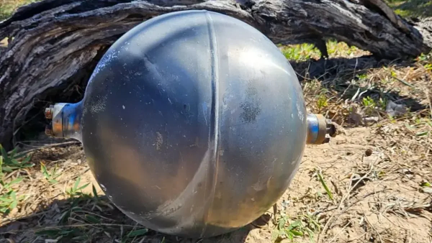
In July 2026, six 'space balls' were found on a beach in North Queensland. The Australian Space Agency reported that these objects were likely to be fuel pressure vessels from a
space launch vehicle. The spherical containers are made of titanium -- a material strong enough to survive the descent through Earth's atmosphere.
Here is an image of the 'space balls" posted by BBC News.
You really do not want to be messing around with this stuff.
With increasing numbers of rockets and satellites launching into space, these incidents are becoming more common.
According to a New York Times article in July 2026, more space debris is raining down on Earth than ever before, with some estimates suggesting that up to a tonne of space junk hits Earth every week. That's around 1000 kg a week.
So far, most of this junk has landed in the sea or remote places, but there is no reason to assume that this will always be the case.
The Australian Space Agency has issued some practical steps to take if you find some suspected space junk:
1. Do not handle the debris.
2. Contact local authorities like the Police or ring 000 if you are worried it might be dangerous
3. Notify the Australian Space Agency -- or ask the authorities to do so
Well ........... You might have heard about the SpaceX rocket stage which smashed into the Moon on August 5th this year.
This bit of space junk was big -- 13.8m long and weighed 4,000kg (about half the weight of a school bus). It was travelling around 8.700 km/h and crashed close to the Einstein Crater on the Moon.
The Korean Pathfinder Lunar Orbiter (KPLO) passed over the site multiple times, taking images of the impact site.
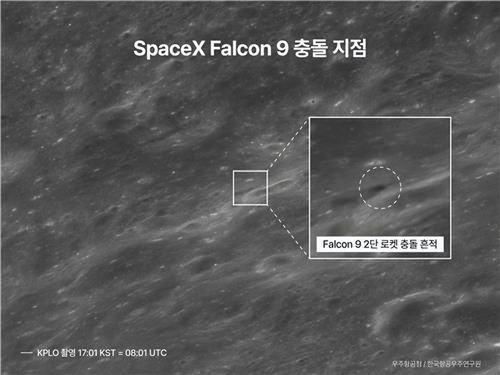
The crash left its own crater and caused a plume of lunar regolith (fine dust) to shoot up into space. Unlike Earth, the Moon has no atmosphere, so there was no friction to slow the object down. It came down hard and fast!
As NASA and China both plan to build lunar bases on the Moon, incidents like this one will be something they will be thinking about how to manage and predict.
As we wander around the Solar System more and more, we will need to think about our impact on otherwise pristine environments.
According to NASA, humans have already left a lot of trash on the Moon, including around 70 landers, rovers, and modules, 96 bags of human waste (yuk!), as well as tools, boots, cameras, and shovels (and flags!). NASA is trying to find ways to reduce, re-use and recycle trash in preparation for the establishment of the first lunar base in the next decade.
It's not like a Council rubbish truck can travel around the Moon or Mars to pick up all this stuff – and where would you put it anyway?
Having millions of pieces of hard rubbish zooming around Earth can't be good! Especially when some of that junk inevitably comes back down to earth.
To stay in orbit, objects must travel at around 27,500 km/h. At that speed, even a very tiny piece of junk can cause damage to, say, the International Space Station, a satellite or even to a spaceship on its way to the Moon.
There is a lot to be thinking and talking about like:
· There is no agreed legal framework to deal with space junk
· We need rules about how to minimise it in the first place, how to prevent accidents and damage, agreement on who is responsible for cleaning up the junk or who owns it when it crashes to Earth (or the Moon)
· A crowded sky makes astronomy challenging and launching spacecrafts, especially with humans on board, hazardous
· How do we manage, prevent or rescue spacecraft or astronauts hurt of damaged by space junk
· With more satellites being launched, how do we manage the greater risk of collisions (and the creation of more junk)
· Smaller satellites like CubeSats have shorter lifespans and can clog up Low Earth Orbit before burning up in the atmosphere
· There is a lack of strong guidelines or regulations to ensure that spacecraft or satellites can dodge debris or withstand these impacts is making it hard to control or manage space junk
· The cost and the practicality of cleaning up space junk will blow out, costing too much for anyone to be able to do anything about it.
More and more countries and private companies are sending satellites and rockets into space.
Don't forget, we all depend on this technology for things like GPS, telecommunications, weather forecasting, exploration and, let's be honest, for protecting ourselves from warring nations.
The problem is not going away.
So far, the legal rules and regulations are not yet in place to properly manage and control space junk. Many scientists think that we desperately need a Global Treaty that addresses some of these issues. We already have an Outer Space Treaty, but perhaps we need an Orbital Activity Treaty to provide a framework to make sure space exploration is safe, responsible, and sustainable into the future.
Such a treaty would require discussion on things like:
· Designing spacecraft using resistant materials, minimising surface area and reducing the number of exposed components
· Monitoring and predicting the movement of objects using tracking software and databases to map locations in real time
· Making sure that all spacecraft and satellites have sensors to detect dangerous objects and are capable of course correction
· Requiring craft to be designed and built with effective shielding, speed reduction capability, tools to nudge debris out of the way and the technology to be able to dodge junk
· Agreeing on principles for disposal, re-use, and recycling of debris in space and on moons or planets
· Ownership and responsibility for space debris
We have a way to go before any kind of treaty can be agreed upon. It will take time and political courage.
We know that the space near Earth is already chock full of junk.
Imagine trying to pick up 140 million pieces of trash! Maybe we need a Clean Up Space Day?
Some smart people are thinking about ways to clean up space rubbish -- like building satellites with claws to grab pieces or capture them in nets. Smaller pieces could then be burnt up in the atmosphere. Other pieces could be recyclable. or reused.
Humans are inventive. In the video below, some current projects are described which are designed to put a dent in the mountain of rubbish piling up in orbit.
Do you have any ideas about how to manage all the space junk?
Maybe your school could take on the problem as a science project?
Let's all work together to protect Space!
When: Friday 21 August at 6pm
Where: Carpark at Marketplace Bendigo, near Discovery Centre
Come and look at the night sky through the telescopes brought in by the friendly and knowledgeable members of the Astronomical Society of Victoria (Bendigo).
I bet you will see some satellites! If the skies are clear, you will definitely see some of the Moon's craters.
Fingers crossed, the clouds will stay away!
Sign Up To Our Mailing List